Sunday, April 10, 2011
Rock ‘n’ Roll, Part II
I) The Rebirth of Rock – the years between 1958 (when Elvis went into the army) and 1963 (when the Beatles broke in the United States) have been portrayed as the low point of rock history, but in reality it was the time when black do-wop groups ruled—except for the white teen idols (Fabian, Frankie Avalon—who appealed to the American Bandstand crowd)
A) Beatles – undoubtedly, the most influential group of musicians in the years after 1950. How many band members in the 1960s and 1970s recounted their first exposure to the Beatles as the beginning of their career in music?
1) Liverpool – in the 1950s, Liverpool was a depressed seaport, with piles of rubble left over from the destruction of WWII, but it supported a huge music scene.
(a) Skiffle – an English interpretation of American folk music (songs like Rock Island Line, etc.). Its biggest star, Lonnie Donegan, performed with more enthusiasm than talent—but that was just the point, and this music inspired hundreds of young people to get a guitar and form a band.
(b) Muddy Water – inspired many of the same young people to perform with amplified music
(c) Search for authenticity – appreciation for indigenous cultural artifact from another culture (namely music) a sign of cosmopolitanism—of “hipness.”
2) Brian Epstein – scion of a family that owned a regional chain of department stores; bored, and afraid that a convicted felon due for release soon would “out” him. Epstein knew little about music, but was a promotional genius.
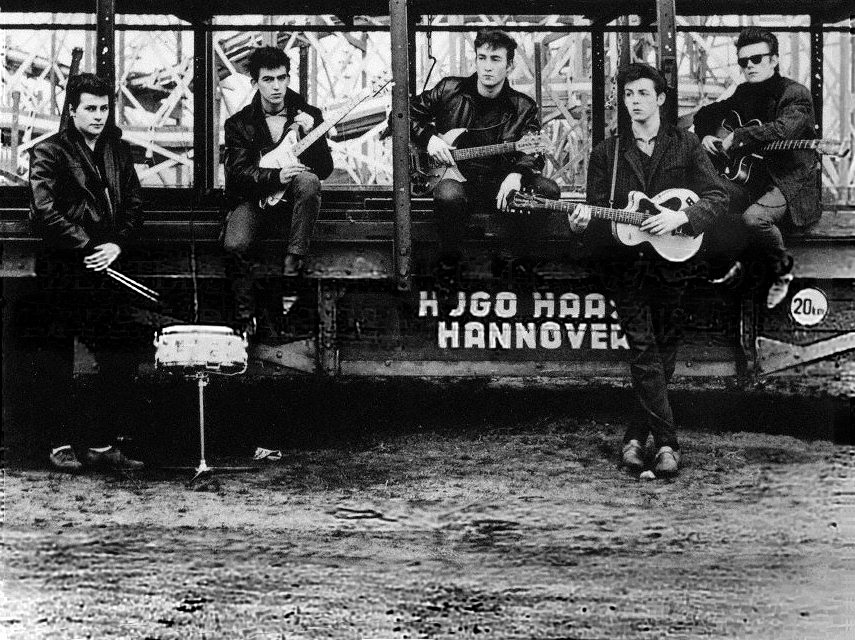
(a) Cleaning up the Beatles image – before Epstein, the Beatles dressed in black and leather. Epstein prevailed on the band to wear suits and neckties—although they kept the “French cuts” (long hair).
(b) Beatles came across as pleasant, intelligent young men, just cheeky enough to appeal to their generation, but not threatening enough that mother would ban them from the house.
(i) This, of course, left the door open for a band to emerge with a more raucous sound and a dirtier image—namely, the Rolling Stones.
(ii) Beatles themselves were loud and raucous, and they brought a new sense of style to rock and roll that the Rolling Stones also followed—a sense of campiness, that all of this was done as kind of an inside joke, which only “insiders” could pick up on.
3) Do It Ourselves – Lennon and McCartney were determined that their band would perform songs mainly written by themselves—a break with past traditions (for instance, although Elvis Presley received song publishing credit, he didn’t really write any songs himself).
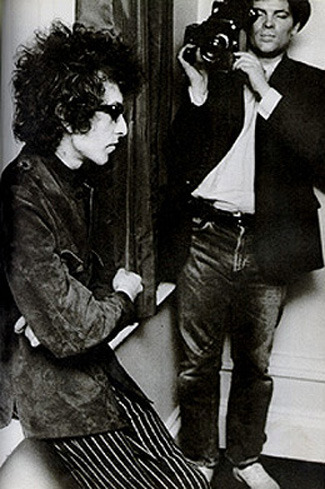
II) Bob Dylan
A) Robert Zimmerman – a bright Jewish kid growing up in Hibbing, Minnesota, listening to black r & b on the radio, as well as country music.
1) University of Minnesota – Zimmerman after high school attended school in Minneapolis, where he discovered what passed for the “bohemian” crowd there, and he began developing the Bob Dylan persona.
(a) Re-emergence of the folk music movement – Folk music first emerged in the early 1950s, but was quashed in the Red Scare led by McCarthy; with McCarthy’s fall, folk re-emerges
(i) Woody Guthrie – Guthrie, a member of the Weavers along with Pete Seeger, cannot re-emerge with the movement he helped inspire because he is stricken with Parkinson’s disease. Dylan, by this time, has copied Guthrie’s repertoire (as well as his style of delivery).
2) Move to New York – after his sophomore year, Dylan moved to New York (really the only city one could make a living as a folk musician); Dylan assumes Guthrie’s mantle, and develops his own repertoire of songs, while retaining much of the persona he appropriated from Guthrie.
3) Stardom – Dylan quickly established himself as the biggest fish in a rather small pond (Joan Baez, Peter, Paul, & Mary, Pete Seeger, etc.), which was good enough until the Beatles arrived.
III) Beatlemania
A) UK – the Beatles built a solid following in the United Kingdom, particularly among young girls, who tended to scream during the entire set (which had gotten shorter, at the insistence of Epstein—about twenty-five minutes, on average).
1) Three things set Beatles apart
(a) Furious energy
(b) Care and diligence that Lennon and McCartney brought to developing their own songs
(c) Demand that they be able to create their own “art”
B) “Phony Beatlemania” – the storied “conquering” of the US is much more complicated than is generally known.
1) Screaming crowds – were hired by Brian Epstein, who also massaged members of the press to spin favorable stories about the band.
2) Successful tour – the initial tour in 1963 was successful, but the Beatles did not initially take the country by storm.
3) “Hard Days Night” – a pseudo-documentary of a day in the life of the band, full of them being chased by young women, and being cute and cuddly. Film was released in 1964, and the band toured US after its release—when the Beatlemania was anything but phony (after American kids were shown how they should act).
4) Critical acceptance – perhaps the most important distinction between rock’s rebirth and its initial creation was that it was an acceptable musical form, particularly as it was performed by the Beatles (not that there was not some opposition to the long-haired freaks, but it was much less vehement the second time around).
IV) Dylan Meets the Beatles
A) Dylan Tours UK – Dylan toured the UK in early 1964, where he was treated by audiences like a rock star—like the Beatles. In fact, Dylan was greatly influential upon the Beatles, who admired his songwriting ability. Dylan, for his part, admired the audience the Beatles were attracting.
1) “I Wanna Hold Your Hand” – Beatles hit, which became ubiquitous in the US in 1964, and which Dylan thought contained the lyrics “Your love, I get High! I get high! I get high!” (instead of “can’t hide”). This becomes an issue of greater amusement after Dylan introduced the Beatles to marijuana in August of 1964. Inserted into one of the songs on the subsequent album, Rubber Soul, was the “I get high!” lyric in the song “It’s Only Love.”
B) Dylan goes electric – in an effort to broaden his audience, upon his return from England Dylan recorded his last acoustic album for many years, Another Side of Bob Dylan, which contained only one overtly political song. In May 1965 he released his first electric album, Bringing It All Back Home, which contained “Subterranean Homesick Blues” which, although a modest success in the US, became his second top ten hit in the UK
1) 1965 Newport Folk Festival – although Dylan was not booed off the stage at Newport while performing with members of the Paul Butterfield Blues Band, his reception was less than enthusiastic, and he pulled the plug after performing only two or three songs (perhaps having more to do with his stoned state than the audience)
(a) Dylan and drug use – Dylan, in an effort to “get to the depths of where you are at” (whatever that means), was increasingly relying upon drugs, particularly marijuana, to get there.
2) 1965 Dylan UK tour – his performance style was becoming increasingly hostile (he refused to perform earlier songs), and his reception there was much less ecstatic than before.
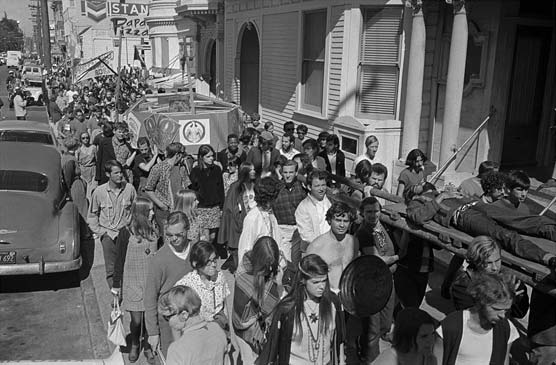
V) Haight-Asbury
A) The Acid Test
1) Ken Kesey and the Merry Pranksters—and LSD
Tuesday, April 5, 2011
Rock ‘n Roll (Part I)
I) Working-class in the South
A) African Americans
1) Sharecroppers in the Mississippi Delta – the Delta area covered much of northwestern Mississippi, between the Mississippi and Yazoo Rivers, and was the area in the state most devoted to the cultivation of cotton, and therefore had a high concentration of descendents of former slaves in the area.
2) Musical traditions – work songs, which helped regulate the pace of labor (as well as help the time pass more quickly); sacred music; both forms used “call and response.”
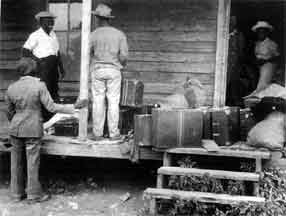
3) Itinerant musicians – the Delta area, before the advent of the juke box and radio, had a tradition of musicians who traveled from plantation to plantation to play music for Saturday night fish fries, and at “juke joints.” For many men (and a few women), this was the only chance for them to avoid a life of back-breaking, ill-paying labor
(a) Charley Patton
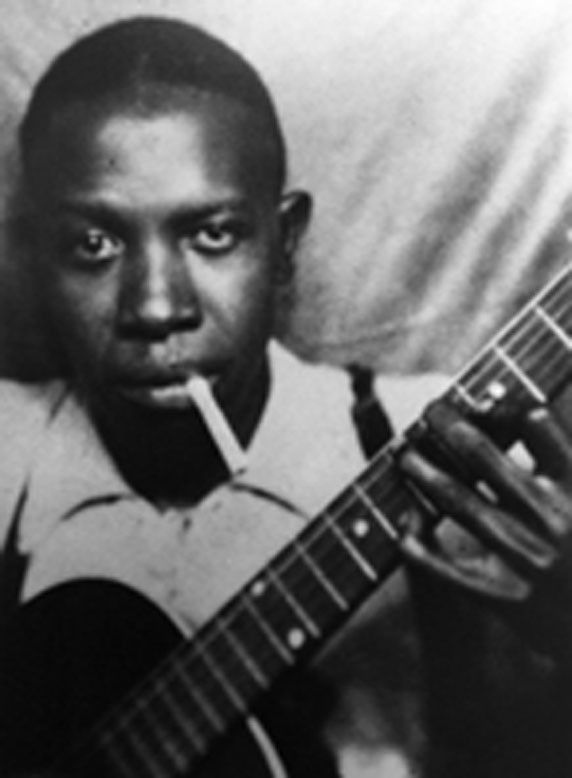
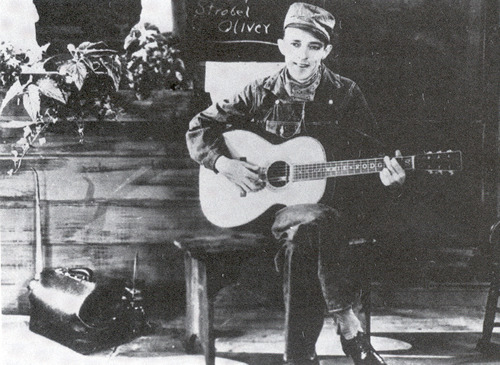
(b) Robert Johnson – became a big star twenty years after his death, when recording of twelve of his songs became the visible sign of “hipness”
(c) Huddie “Leadbelly” Ledbetter
(d) B.B. King
(e) Muddy Waters
(f) Howlin’ Wolf
4) Movement off farms into cities – so-called “chain” migration—migrants often first moved into cities in the South, and then into cities in the North from there
(a) Pull of wartime employment – as jobs opened up to African Americans in factories and docks in the North, many left farms to fill these jobs in the North.
(b) Push of mechanization – after the war, cotton cultivation became increasingly mechanized, which meant that it was cheaper for large landowners (plantation owners) to buy tractors, cultivators, etc., and dismiss their sharecroppers—which in turn meant that these sharecroppers were forced to move off the land that they had cultivated; many chose to move into cities.
B) Poor white southerners – segregation, that we think of as personifying life in the South (and in the North, for that matter), is really an urban phenomenon than something that takes place in a rural environment; poor southern whites often found themselves in similar situations as their African American neighbors.
1) Tenant farmers – depressed farm prices had earlier forced many tenant farmers off farms and into cities, north and south.
(a) Secular – “hillbilly” music; without radio, many people had to entertain themselves, and their neighbors. White musicians in the south had a long tradition of learning music from their African American neighbors
(b) Sacred – prevalence of Pentecostal religions in the South (both white and black) meant that adherents to these various sects were familiar with emotionally charged music, from their church services.
3) Movement off farms and into cities – for many of the same reasons that African Americans moved into cities; same kind of chain migration as was the case with African Americans.
(a) Wartime employment
(b) Mechanization of farming in the south
II) Radio – radio became the vehicle for popularizing “race” music among a wider audience
A) Clear Channel Stations – (not those of the company of today) in the late 1940s and 1950s, there were a number of 50,000-watt (the largest the government would allow) stations that could be heard (best at night) over much of the country—the so-called “clear channel” stations.
1) WDIA—white-owned radio station in Memphis that began playing “race” music, and featured African American radio personalities, including Riley “Blues Boy” King (better known to us today as B.B. King) and Rufus Thomas, both of who became well-known performers of blues and rhythm and blues (R & B) music.
2) WHBQ – white-owned radio station in Memphis began playing “race” music at night for the African American audience in the city, and as a result a number of white audience members were exposed to the music, as well. DJ Dewey Phillips’ nightly show, “Red, Hot and Blue” became a particular favorite.
3) WLAC – Nashville record station, where a local business, Randy’s Record Mart (which did a big mail-order business), sponsored a blues radio show at night. The owner also owned Dot Records, which began releasing recordings of popular r&b songs redone by white artists—in particular, Pat Boone (whose first big hit was “Ain’t That a Shame”)
B) Sam Phillips and Sun Records
1) Sam Phillips – white engineer opened Memphis Recording Service, and began to seek out local African American talent to record. Phillips quickly became frustrated at the limited sales that the race music was able to attain, and he begins to seek out a white singer to perform music in this style.
(a) How does Phillips know that such a person exists? – because he himself enjoys such music, and is confident that other white southerners feel the same way, and are performing such music out there somewhere.
III) Elvis
A) Childhood – Elvis was an only child (his twin brother, in fact, died soon after he was born) brought up by a doting, domineering mother and a largely absent father.
1) Pentecostal church upbringing – Elvis attended sanctified churches with his parents, where he would have been exposed to the emotionally charged services that these churches are known for.
2) Working-class upbringing – Elvis’ childhood was rather economically distressed, his father worked a series of rather low paying jobs. Elvis grew up in Tupelo, MS, and although the public schools that he attended were segregated, and the public facilities (theaters, restrooms, etc.) were segregated by race, the town itself was only segregated by income.
3) Father imprisoned – when Elvis was growing up, his father was imprisoned for several years after an attempted robbery, which did not affect the social standing of the family in the city, but only confirmed their outsider status there.
B) Move to Memphis – some time after his father was released from prison, the Presley family moved from Tupelo to Memphis, where Elvis eventually graduated from high school, and held down several rather low-paying jobs driving trucks.
C) Recording of song for mother – to surprise his mother on her birthday, Presley recorded a song at the Memphis Recording Service—which led eventually to his being courted by owner Sam Phillips to record some music with two musicians that he had worked with
D) The Sun Records years – (both of them) Elvis cut only six singles with Sun, but they changed popular music forever.
1) The marriage of white and black sensibilities – Elvis was able to cross boundaries that were thought to be impossible to cross; it was probably no accident that his first successful recording included a countrified version of a rhythm and blues hit, and a rhythm and blues treatment of a country hit.
2) Elvis’ demeanor
(a) Loved “loud” clothing (bought at Lansky Brothers, which catered to a largely African American clientele); and he favored pink particularly (which at that time was not a color that most men would have been caught out in public in).
(b) Use of make-up – like Little Richard (although perhaps for different reasons), Elvis used make-up (eye-liner and eye-shadow) not only when he was performing, but in everyday life.
(i) Explanation of Elvis androgynous appeal – males tended to like Presley’s music, if not his performance style (which females reacted to vociferously)
3) Inspiration of others – many other white performers followed Presley to Sun Records, and eventually to other record companies, as well
IV) Race, Class, and Rock ‘n Roll
A) Chuck Berry—Berry was in many ways the mirror image of Elvis Presley, although he was much more talented as a musician than Presley was.
1) Childhood—Berry was born into a middle class family in St. Louis. Despite that, he was convicted at age 18 of armed robbery, and spent a year in prison between 1946 and 1947. After his release, he settled into married life, working for a time in an automobile factory before becoming a hair dresser.
2) Musical career—Berry was able to get hired as a guitarist for a popular St. Louis “jump blues” group, the Johnny Johnson trio. After breaks in the clubs they played, Berry would sometime entertain the crowd with “bluesified” versions of country music numbers then popular on the radio. When Johnson left St. Louis to pursue a recording career with the Chess Record Company in Chicago, Berry took over leadership of the group.
3) Chess Records—was owned by two Polish-American brothers, Leonard and Phil Chess. The company specialized in blues, rhythm and blues, and gospel records, aimed at an African American audience. The Chess brothers developed a business relationship with Sam Phillips, and handled some of the overflow from Sun Records. When Elvis hit, the Chess brothers were inspired to seek similar talent of their own.
B) The Day the Music Died
1) February 1958 – Buddy Holly, Richie Valens, and The Big Bopper die in plane crash in Iowa
2) Jerry Lee Lewis – brought down by his marriage to his 14 year old cousin
3) Chuck Berry – convicted of violation of the Mann Act (transporting a 14 year old across state lines for illicit purpose).
4) Elvis – drafted, enters service, and out of the limelight for two years (his transportation of a 12 year old across international borders received little notice); after his hitch is done he concentrated on movies.
C) Re-invention of rock--these events in 1958 are seen as the end of rock's first era. The Top 40 charts from 1958 to 1963 were dominated by pop music--particularly by male singers produced by Bob Marcucci in Philadelphia and girl groups produced by Phil Spector in New York City. Oh, and a whole host of African Americans on a record label called Motown, out of Detroit.
Sunday, April 3, 2011
America’s Second Reconstruction
I) The Beginning of the Modern Civil Rights Movement
A) New Deal – from 1935-1936, African Americans were an important part of the “New Deal Coalition,” which demanded, like other members of that coalition (white ethnics, labor, etc.) made demands upon the government which they expected would be met.
B) 1943 March on Washington – although this march never really took place, the fact that the President (FDR) reacted by creating the Fair Employment Practices Committee (FEPC) was a victory for African American activists.
C) NAACP – from the outset of the New Deal, the NAACP had been pursuing a number of lawsuits in order to overturn the practice of “separate but equal” that had been institutionalized since Plessy v. Ferguson.
1) Brown v. Board of Education – in 1954, the Supreme Court handed down a decision in a case in which an African American parent had sued the Topeka (KS) board of education over the maintenance of separate schools for white and black students. The Court agreed with plaintiff Brown that separate school systems were inherently unequal, and directed that the practice be ended with “all deliberate speed.”
2) Federal Government’s Amicus Brief—the Truman administration filed a number of amicus briefs supporting challenges to segregation that argued that the foreign policy interests of the United States were threatened by the continuation of segregation.
II) Southern White Reaction – Brown v. Board of Education has long been held as the beginning of the of the modern civil rights movement; but what the decision really signaled was the recognition on a part of some whites in government that African Americans should be accorded full rights as citizens, largely to further the aims of the Cold War. Not all whites were willing to recognize this fact, however, inside or outside of government.
A) Massive Resistance – the vow on the part of most southern white politicians to resist any and all efforts on the part of the federal government to integrate southern institutions.
1) Little Rock Arkansas – one of the earliest integration efforts was at Central High School in Little Rock, Arkansas in 1957. Central High School was, to this point, attended largely by white working-class students (the integration of working-class schools is a practice that would be repeated around the country—including places like Boston). The governor of Arkansas, Orville Faubus, promised to resist the federal government order to integrate Little Rock schools. A huge crowd of whites turned out to jeer and threaten and throw rocks at the ten African American students who attempted to enter the school the first day. Reluctantly, President Eisenhower called out the 101st Airborne Division to ensure that students in Little Rock could attend school.
2) University of Mississippi – rioting broke out, with whites going on a rampage that again had to be quelled by the 101st Airborne (including members of the fraternity of which Republican US Senate leader Trent Lott was president of—where twenty-seven weapons were confiscated), when James Meredith attempted to enroll at the University.
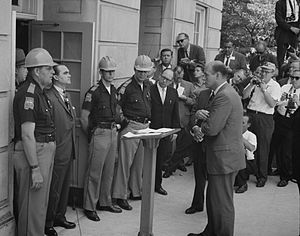
3) University of Alabama – George C. Wallace proclaimed that he would stand in the school house door to prevent any African American students from enrolling at the university—which he did, although he quickly stepped aside once his point had been made.
III) African American Action – the white reaction of massive resistance did not come mainly from government action, but from the pressure that African Americans, mainly young people (college and high school students), placed on the government to live up to the promise of equal opportunity.
A) Montgomery bus boycott (1955)
1) Rosa Parks – Mrs. Parks was much more than the popularly portrayed old woman who was tired from a day at work; she was secretary of the local NAACP chapter, and had had regular run-ins with the Montgomery Bus Company over her treatment on the buses.
2) E.D. Nixon – Nixon was an official in the local chapter of the Brotherhood of Sleeping Car Porters, and the president of the NAACP chapter; at the beginning of the boycott, he sought out all the local black ministers to lead the boycott, feeling that this would make it seem less radical to other blacks; he first asked the new minister at the Third Baptist Church, Martin Luther King, who declined; after all other ministers also declined, Nixon was able to persuade King to assume the responsibility.
(a) Nixon and others coordinated the car pool service, which replaced the bus service in the black community; many of the drivers were college students who stayed home to provide the service
3) Martin Luther King, Jr. – feared about maintaining his new pastorate, with this high-profile task, and about the safety of his family (rightly, as it turned out, since shortly after his assuming leadership of the boycott his home was firebombed)
(a) After nearly a year, the Montgomery Bus Company capitulated, and agreed to remove the boards that segregated the riders.
B) Result of the success of the boycott guided King into a new role
1) Greensboro, NC – Greensboro was a city that prided itself on its progressive race relations; when 4 North Carolina A & T freshmen—Ezell Blair, Jr., David Richmond, Joseph McNeil, and Franklin McCain—decided to sit at the Woolworth’s lunch counter on February 1, 1960. The next day, these four were joined by twenty more; and eventually hundreds more (including a contingent of white female students from the nearby North Carolina Women’s College)
(a) Inspired black students throughout the south to similar actions.
2) Nashville, TN – led by students from the American Baptist Theological Seminary and Fisk University like John Lewis, Marion Berry, and Diane Nash, who were in turn led by a northern born black minister named James Lawson, who was committed to using Gahndian non-violent methods to foster social change.
3) Atlanta University – the “Black Ivy League;” led by Lonnie King and Julian Bond, who attempted to integrate public facilities in Atlanta; group was quickly arrested and they spent most of the day in jail—but this action turned middle-class blacks into freedom fighters.
D) Student Nonviolent Coordinating Committee (SNCC) – at a meeting on April 16, 1960 in Raleigh, NC SNCC was formed; decided to remain independent from other civil rights organizations like NAACP, CORE, and SCLC.
E) Freedom Rides (1961)
(a) Birmingham, AL –1st bus was allowed to leave but the KKK firebombed the bus on the highway, and the passengers were beaten as they tried to escape the inferno, until the US Marshall accompanying them drew his pistol and fired it into the air; 2nd bus of riders was set upon the group of whites at the bus station in Birmingham, and were allowed to beat passengers for five minutes before police showed up (by pre-arrangement).
(b) Mississippi – less violence then in Alabama, but the passengers were arrested and charged with “inflammatory riding,” saddled with high bails and eventually with unreasonably long jail terms (some even served time at Parchman Farm)
F) Albany (GA) Movement (1962) – an attempt by local African Americans to integrate public facilities, and to open bi-racial talks; the movement was led by SNCC until a local group called in King, which led to a sometimes bitter internal struggle. Albany police chief Laurie Pritchett restrained his officers from publicly abusing the protesters; the lack of conflict led to an overwhelming defeat.
G) Birmingham – after the lesson of Albany, King realized that he for nonviolent tactics to be successful, he needed a foil that would be more physically active than Pritchett.
1) Television – the violence of the Birmingham police, and their attack dogs and high-pressure hoses, repulsed much of the nation—and won a great deal of sympathy for the civil rights movement
2) Youth join the Movement – as more adults were arrested in Birmingham during the protests, King okayed the use of teenagers (and younger children) who faced Bull Connors’ police and dogs and fire hoses, which increased the impact for viewers on television.
3) “Letter from Birmingham jail” – King’s most famous writing distilled the aims of civil rights movement.
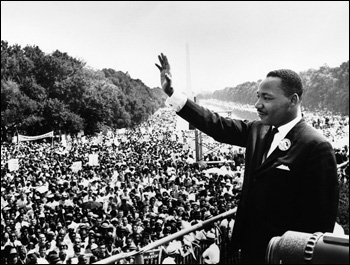
H) March on Washington – King’s “I have a Dream” speech, which was predated by a much angrier speech by SNCC leader John Lewis (which was less angry then it was originally intended, because the UAW’s Walter Reuther threatened to pull the union’s funding from the March).
I) Civil Rights Act (1964) – LBJ’s greatest moment, despite the rift it caused with former Senate colleagues.
J) Freedom Summer (1964) – the program created by SNCC to register black Mississippians to vote; recruited black and white college students, who were trained in nonviolent tactics at Miami University in Oxford in the spring of 1964.
1) White volunteers – SNCC first recruited a large number of white volunteers in 1963, in an early voter registration drive.
2) 1964 – more whites joined the effort; the hope of SNCC leaders was that by having prominent whites involved (including the son of California governor Pat Brown—Jerry Brown) there would be less danger for all involved
3) “Mississippi Burning” – three SNCC volunteers—one black and two whites—were kidnapped and murdered by the KKK
(a) Inordinate attention paid to the deaths of the white volunteers, which caused resentment among SNCC members; from this point white members are asked to leave the organization, and the black pride attitude becomes more prevalent.
K) Voting Rights Act (1965)
1) Selma – home to another reactionary racist, Sheriff Jim Clark; the police chief Wilson Baker maintained peace in the city early on—which hindered the voting rights campaign greatly.
(a) Decided to begin marching registrants to the Dallas County Courthouse, which Clark found provoking; Clark responded by ordering his deputies to beat protestors, despite the presence of television cameras
(b) “Bloody Sunday” – March 7, 1965; Hosea Williams and John Lewis led marchers, who were met at the Pettis bridge by the combined force of the Dallas County deputies an the Alabama State Troopers, who descended upon the marchers with a rebel yell and club all marchers they could reach senseless; ABC interrupted the movie “Judgment at Nuremberg” (the trial of another group of racists) to broadcast footage of the carnage.
(c) Presidential address – LBJ addressed a joint session of Congress calling for the passage of the Voting rights act, and quoted the famous song of the Movement “We Shall Overcome.”
(d) March 21—march to Montgomery resumes; Wallace was called to Washington and given the “Johnson treatment.”
(e) Bill signed into law August 6, 1965.
1) Memphis Sanitation Workers’ Strike—1,300 municipal workers in Memphis walked off their jobs in protest of years of ill-treatment. Just a week before, 2 sanitation workers were crushed to death in a malfunctioning garbage truck. Many sanitation workers, in fact, still qualified for welfare after working a 40-hour week. African Americans were relegated to the dirtiest, lowest-paying jobs, with not chance for advancement. In addition, African American workers were regularly verbally abused by white supervisors, including grown men being referred to as "boy."
2) Assassination of MLK--King had earlier visited Memphis, at the beginning of the strike, and promised to return to assist the workers in their struggle. King returned to the city on April 3, and a huge rally was held that evening at a local African American church. The next evening, as King was waiting to go to dinner on the balcony of the Lorraine Motel, he was shot and killed by an assassin hidden in a building across the street. Mayor Henry Loeb still refused to negotiate with the sanitation workers, however, and President Lyndon B. Johnson sent his own negotiator to settle the dispute. An agreement was finally reached on April 18 that ended the strike; the union had to threaten another strike that summer, however, to get the city to live up to that agreement.
IV) Conclusion
Tuesday, March 29, 2011
Assignment 11
With the end of World War II, the government of the United States turned much of its attention to winning the ideological war with the Soviet Union. This "cold war" had obvious implications internationally, and in the foreign relations of the United States--but it also had definite domestic policy implications, as well. Identify and discuss at least two of these two of these policies, paying particular attention to how they affected both international relations and domestic policy. This assignment is due April 6.
The New Normalcy
I) Political scene
A) 1952 Presidential Election
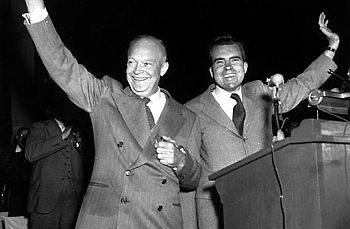
1) “I Like Ike” – one of the heroes of the Second World War, Dwight D. Eisenhower, who had engineered the Allied victory in Europe
2) 8 Millionaires in the cabinet – displaying the linkage between the military and business from the war years
3) Retained many New Deal programs
B) Cold War on the cheap
1) Reliance upon nuclear weapons
(a) John Foster Dulles – believed that the US needed to remove the taboo from using nuclear weapons
(b) Promise of “Massive Retaliation” – the doctrine of Massive Retaliation advocated by Dulles; the promise of total annihilation should the US ever face a nuclear attack itself (led to the understanding of “Mutually Assured Destruction” on the part of the US and the USSR).
(c) Civil Defense – the ludicrousness of “survival” in the event of nuclear war.
II) Economic and social life in the 1950s
A) Postwar Economic Boom – from the end of WWII to the early 1970s, the US experienced a period of unprecedented economic growth
1) Car Culture – epitomized US society during these years; the car culture emphasized the consumption
(a) Consumption of consumer goods
(b) High wage jobs – (for union members, anyway), which allowed consumers to buy the goods that advertising convinced them that they wanted.
(c) Movement to the suburbs – for whites
(d) Example of Detroit
B) Modified Keynesian economics – government was to use its power to tax and spend in order to regulate the consumer demand for goods and services (example: the price of gasoline, which had been kept artificially low in the US because it was a desirable policy to encourage the purchase of individually owned automobiles, rather than have the price reflect the true social cost of all of the automobiles on the road)
1) Legacy of the New Deal
(a) Liberals – wanted to sustain economic growth by sustaining consumer purchasing power through government spending on programs like public works, schools, housing, Social Security and unemployment insurance.
(b) Conservatives – feared liberal programs would erode market incentives; advocated tax reductions for businesses instead
(c) Stalemate – taxes remained high on business, but government spending on social programs grew slowly; much of the money went into the military build-up, which represented a means of government spending that conservatives found more palatable
2) Labor and social programs
(a) Health insurance – this benefit was bargained for by large unions, because they expected large corporations to balk at paying the costs for this, and would therefore lobby the government with the unions to create a European-styled national health plan—but instead corporations decided to pass the additional costs of theses plans on to consumers who bought the products they manufactured.
(b) Wages – because of contracts, wages grew independently of market pressures, which shortened the length of recessions considerably.
3) Military spending – by 1950, approximately half of the US budget was devoted to the military, and military “needs” affected a large portion of the rest of the budget.
(a) Economic growth – especially in the South and the West Coast, where many military installations were located—and where the industries serving the military re-located—fueled much of the economic growth during this period.
(b) Social programs – Educational programs (like the GI Bill), medical care (VA hospitals), housing (VA loans) all expanded during this period, uncontroversially. Perhaps the post-war program that had the greatest effect on America, the Interstate and Defense Highway Program, was established in 1956 because of the perceived need for the military to be able to move around the country quickly
C) Era of Labor-Management Peace – despite some rather high-profile strikes during the 1950 (like the steel strike in 1959—one of the longest in history, to that point—the era was marked by a new labor-management understanding in their relationship to one another.
1) The labor-management tacit agreement
(a) Management agrees to high wages for union members
(b) Well-established unions were insulated from assault from corporations
(c) Unions had to accept management decision making power on the shopfloor and in the boardroom
2) Non-competition for workers – corporation in the same industries agree not to compete for labor, which helps to establish the era of pattern bargaining. The rising cost of labor is met, however, by general rise in prices for the goods produced.
(a) Only possible in maturing industries – industries where the number of firms within an industry had already been reduced by attrition and merger
(b) Workers for these larger corporations were protected from inflation by the Cost-of-Living-Adjustment (COLA); first introduced during negotiations between the UAW and GM in 1948
(i) COLA was pegged to the Consumer Price Index (CPI)
(ii) Workers also got 2% “annual improvement factor” designed to give workers a portion of the productivity gains made by corporations.
3) “Treaty of Detroit” – the 1950 UAW/GM contract
(a) Unprecedented five year contract (which the union never repeated, because despite the economic innovations the wage rise did not keep up with inflation)
(b) By the end of the 1950s, COLAs were a feature of even contracts for employees of non-union companies.
4) What price peace?
(a) End of the “wildcat strike” – companies insisted that production be uninterrupted during the life of the contract (like the Treaty of Detroit example)
(b) Company insistence upon longer terms for contracts—which help them control labor costs
(c) All disputes that arose during the life of the contract were to be handled only through official channels—usually through the established grievance process. This meant that union officials became contract police; in effect the union became the arbitrator between the company and its employees, rather than the advocate for its members.
5) Labor merger – in 1955, the AFL and the CIO merged; the new organization was headed by the former president of the AFL, a former plumber named George Meany, who boasted that he had never led a strike.
(a) Merger of unequal partners – at the time of the merger, the AFL was twice the size of the CIO
(b) Labor during this period became increasingly reliant upon the Democratic Party, while receiving less and less for this support.
6) Labor corruption – was especially prevalent in decentralized, highly competitive industries like trucking (Teamsters), restaurant (Restaurant Employees), and dock work (ILA)
(a) Jimmy Hoffa and the McClellan Committee
D) Deindustrialization
1) Flight from the farm
(a) Mechanization of cotton farming – did away with the need for cheaply employed labor; large landowners began encouraging sharecroppers to move north, to rid themselves of obligations.
(b) Mechanization decreased the need for casual labor – farms that do still need casual labor come to rely more and more upon migrant labor, principally from Mexico and the border area with Mexico.
(c) Black and white farmers and laborers continue to move north during the 1950s
(d) Rural immigrants from Puerto Rico begin moving to the United States during this time period as a result of the mechanization of the sugar cane industry.
2) Suburban homogenization
(a) Decline of ethnicity – mass migration from Europe had largely stopped for almost two generations by this point; there was a rise in attendance in public schools through high school; there was also a decline in the number of Catholic Churches organized along ethnicity during this time period.
(b) Suburban tract housing – enforced sameness in appearance, initially
(i) William Levitt and the Levittown(s) – met pent-up demand for housing; government policies also encouraged the development of detached single family dwellings
(c) Public housing – developed into high-rise, prison-like institutions, particularly those developments built to accommodate poor blacks moving north.
III) Conclusion
Sunday, March 27, 2011
The End of the Hot War – and the Beginning of the Cold War
Japanese Artist Maps History of the World’s Nuclear Explosions (1945–1998)
- Watch more Politics Videos at Vodpod.
I) The Home Front
A) Centralized planning – 1941 was a banner production year for the auto industry, which was reluctant to abandon civilian production to make war material, and did so only under duress (and the promise of guaranteed profits of cost-plus contracts).
B) “Dollar-a-year-men” – executives from the US firms who came to Washington to help the military plan the economy
1) War Production Board – set prices and determined production
2) Suspension of anti-trust laws – encouraged the formation of larger firms, which officials in the military believed would better meet their production criteria—and which made procurement easier.
3) Construction of new factories – at the governments expense, or with low cost government loans (often, after the war, these factories that the government owned were sold to private industry for pennies on the dollar
4) Cost-plus contracts
C) War Labor Board – arbitrated labor-management disputes; set wage rates for all workers. In return, labor officials promised to abide by a “no-strike” pledge, which individual workers supported, except when it involved their own grievances at work.
D) Office of Price Administration – set price ceilings for almost all consumer goods.
E) Selective Service – FDR administration followed the practice of Woodrow Wilson, and instituted a wide-ranging conscription program.
F) War Manpower Commission – determined which workers work was vital to the war effort (which would prevent them from being drafted); also determined when workers could change jobs.
G) Concentration of the Economy
1) Procurement system – fostered further concentration of the US economy; by the end of the war the top 100 companies held 70% of all civilian and military contracts, compared with 30% five years before.
2) Industrial boom
(a) By 1943 unemployment disappeared
(b) Second Great Migration – whites and blacks leave the South for the Midwest and the West Coast, where most of the jobs created by this economic boom are to be found.
3) Real income growth – 27% between 1939 to 1945
(a) Redistribution of wealth – income of those at the bottom of the wage scale grew at a faster rate than the heavily taxed incomes at the top of the scale.
4) Americanization push – although there were ugly, racist aspects of this new push toward Americanization, it was not anti-European immigrant; in fact, most propaganda celebrated the ethnic diversity of America.
B) Rosie the Riveter – women began to move into industrial jobs in unprecedented numbers during the war years; although most were force to give up those positions at the end of the war, they fought hard to remain in those positions, and a significant number of women remained in the industrial workforce after the war.
1) Male resistance – women who moved into these jobs faced tremendous amounts of resistance from the males who remained on these jobs (give examples of harassment)
2) Working mothers – faced problems relating to the lack of childcare, and the related problem of the alleged juvenile delinquency that their neglect caused.
3) Role of women in society – remained largely unchanged; many saw women in these kinds of positions as temporary war expediency.
C) Wartime intolerance
1) Conscientious Objectors – most Americans have little patience for fellow citizens who refuse to take direct part in a war, whether for reasons of religious principles or any other principles
2) Japanese Americans – removed from the West Coast, allegedly because of the danger of their disloyalty—although much of their property was seized.
(a) Many Japanese American men were drafted (or chose to join the military to get out of internment camps) in 1944; some of these men were among the group that liberated the survivors at Dachau.
(b) Internment was upheld by the Supreme Court
3) Life in the Jim Crow Army
(a) Egalitarian White Army – much had been made of the role the army played in promoting sense of acceptance for children of European immigrants as true American citizens; African Americans, although they served in the military, were never extended this courtesy.
(i) Universal draft – greater mixture from various regions than in previous wars.
(ii) Homosexuality – “Don’t ask, don’t tell” was the unofficial policy; homosexuality was tolerated as long as it was not discovered.
(b) African Americans in the military – excluded from the Marine Corps, Coast Guard entirely, from the Army Air Corps until 1943.
(i) Segregated training camps – not surprising, since many of these camps were in the South
(ii) Segregated service – African Americans were relegated to the quartermaster corps, providing labor and transportation services for frontline troops—until crisis like the Battle of the Bulge.
(i) Tuskegee Airmen.
4) Birth of the modern civil rights movement – irony in the fact that the war was being fought in part against the racist German government when pogroms and discrimination were actively encouraged (or at least tolerated) by various governments in the US.
(a) Growth of the NAACP during the war
(b) “Double V” campaign – victory over fascism abroad, and against racism at home
(c) CIO – the CIO, at the leadership level, was relatively colorblind (at the level of the shopfloor, however, white workers were extremely interested in maintaining the privileges of their race).
(d) March on Washington – threatened protest led by A. Philip Randolph to expose the discriminatory hiring practices of government contractors; federal government passed the Fair Employment Practices Committee (FEPC), which was somewhat successful in removing constraints on the hiring of African Americans.
(e) Racial tensions
(i) Detroit riot 1943 – in the aftermath of the Sojourner Truth Homes riot, racial tensions remained extremely high in the city, exacerbated by the tight housing market (especially for African Americans), and the large numbers of new residents.
(ii) Zoot Suit Riots – sailors, soldiers, and Marines antagonism against African American and Mexican American wearers of so-called “zoot suits” (describe)—often stripping the wearer of his clothing. This antagonism between the two groups was heightened because these military personnel were often cruising African American and Mexican American neighborhoods looking for prostitutes—which they assumed meant any unescorted female in the area.
II) End of the Hot War
A) Victory in Europe – pretty much a forgone conclusion after the successful landing at Normandy; Allied forces were able to advance on German forces from left and right.
B) Victory in Japan – the beginning of the Atomic Era
1) Atomic Bomb – the Manhattan Project was able to produce three atomic bombs by the summer of 1945
2) Why Japan?
(a) Payback to Japanese for Pearl Harbor, Bataan (death march), other atrocities
(b) Limit the amount of territory that would have to be surrendered to the Soviet Union for its “sphere of influence” in Asia
(c) Limit number of American casualties – fears of massive casualties from an invasion of Japan.
(d) Racist feeling toward Japanese, which also fueled earlier movement to use of internment camps.
3) “Spheres of influence” – agreement between FDR, Churchill, and Stalin that would provide Soviet Union control of the countries immediately were surrounding the country so that the Soviets could maintain a buffer to decrease the likelihood that they would be invaded.
4) Soviet entry into Pacific – the Soviet Union was scheduled to begin its role in the PTO by August 8
5) Hiroshima – bomb dropped on August 6, 1945; 80,000 people burned to death instantly, tens of thousands died soon afterward from the effects of radiation; five square miles were leveled by the blast
6) Nagasaki – bomb dropped August 8, 1945; 35,000 were killed instantly; 1 ½ square mile was leveled.
7) Surrender – surrender formally signed on September 2, 1945—VJ Day
C) Alternatives – Smithsonian controversy over the Enola Gay display; most veterans of the war do not want to hear of any alternatives to dropping the bombs, because they believe that dropping the bombs saved their lives. There was strenuous opposition on the part of the generals advising Truman, however, who did not believe the intentional slaughter of civilians, which was clearly going to be the case in the two targets chosen in Japan, was any way to conduct a war (they wanted to limit civilian casualties to “collateral damage”).
1) No invasion was planned until November 1945
2) Japan had signaled a willingness to surrender months beforehand.
D) Allied fallout
1) Death of FDR – dynamics between the leaders of Great Britain, Soviet Union, and United States changed greatly with death of FDR; Truman less confident of abilities than FDR, nor did he initially inspire much confidence. Truman was much more likely to follow the lead of Churchill, who was vehemently anti-Communists; Truman was anti-Communist himself, and distrusted Stalin greatly.
Subscribe to:
Posts (Atom)