Tuesday, April 10, 2012
Written Assignment 13
Although leaders of the Civil Rights Movement--like Dr. Martin Luther King, Jr.--made important contributions to overturning the system of segregation in the United States, so did many people who are largely unmentioned in history textbooks. After watching the brief film clip from Freedom Riders, and considering what you've read in the textbook and what was discussed in class, answer the following question in a 2-3 page paper, due Tuesday, November 22: Why did blacks and whites willingly put their lives on the line to integrate the South? Have they succeeded?

Freedom Riders


ABOUT THE FILM
FREEDOM RIDERS is the powerful harrowing and ultimately inspirational story of six months in 1961 that changed America forever. From May until November 1961, more than 400 black and white Americans risked their lives—and many endured savage beatings and imprisonment—for simply traveling together on buses and trains as they journeyed through the Deep South. Deliberately violating Jim Crow laws, the Freedom Riders met with bitter racism and mob violence along the way, sorely testing their belief in nonviolent activism.
From award-winning filmmaker Stanley Nelson (Wounded Knee, Jonestown: The Life and Death of Peoples Temple, The Murder of Emmett Till) FREEDOM RIDERS features testimony from a fascinating cast of central characters: the Riders themselves, state and federal government officials, and journalists who witnessed the Rides firsthand. The two-hour documentary is based on Raymond Arsenault's book Freedom Riders: 1961 and the Struggle for Racial Justice.
I got up one morning in May and I said to my folks at home, I won't be back todayDespite two earlier Supreme Court decisions that mandated the desegregation of interstate travel facilities, black Americans in 1961 continued to endure hostility and racism while traveling through the South. The newly inaugurated Kennedy administration, embroiled in the Cold War and worried about the nuclear threat, did little to address domestic civil rights.
because I'm a Freedom Rider. It was like a wave or a wind that you didn't know where it was coming from or where it was going, but you knew you were supposed to be there.
— Pauline Knight-Ofuso, Freedom Rider
"It became clear that the civil rights leaders had to do something desperate, something dramatic to get Kennedy's attention. That was the idea behind the Freedom Rides—to dare the federal government to do what it was supposed to do, and see if their constitutional rights would be protected by the Kennedy administration," explains Arsenault.
Organized by the Congress of Racial Equality (CORE), the self-proclaimed "Freedom Riders" came from all strata of American society—black and white, young and old, male and female, Northern and Southern. They embarked on the Rides knowing the danger but firmly committed to the ideals of non-violent protest, aware that their actions could provoke a savage response but willing to put their lives on the line for the cause of justice.
Each time the Freedom Rides met violence and the campaign seemed doomed, new ways were found to sustain and even expand the movement. After Klansmen in Alabama set fire to the original Freedom Ride bus, student activists from Nashville organized a ride of their own. "We were past fear. If we were going to die, we were gonna die, but we can't stop," recalls Rider Joan Trumpauer-Mulholland. "If one person falls, others take their place."
Later, Mississippi officials locked up more than 300 Riders in the notorious Parchman State Penitentiary. Rather than weaken the Riders' resolve, the move only strengthened their determination. None of the obstacles placed in their path would weaken their commitment.
The Riders' journey was front-page news and the world was watching. After nearly five months of fighting, the federal government capitulated. On September 22, the Interstate Commerce Commission issued its order to end the segregation in bus and rail stations that had been in place for generations. "This was the first unambiguous victory in the long history of the Civil Rights Movement. It finally said, ‘We can do this.' And it raised expectations across the board for greater victories in the future," says Arsenault.
"The people that took a seat on these buses, that went to jail in Jackson, that went to Parchman, they were never the same. We had moments there to learn, to teach each other the way of nonviolence, the way of love, the way of peace. The Freedom Ride created an unbelievable sense: Yes, we will make it. Yes, we will survive. And that nothing, but nothing, was going to stop this movement," recalls Congressman John Lewis, one of the original Riders.
Says filmmaker Stanley Nelson, "The lesson of the Freedom Rides is that great change can come from a few small steps taken by courageous people. And that sometimes to do any great thing, it's important that we step out alone."
Sunday, April 8, 2012
America's Second Reconstrution
I) The Beginning of the Modern Civil Rights Movement
A) New Deal – from 1935-1936, African Americans were an important part of the “New Deal Coalition,” which demanded, like other members of that coalition (white ethnics, labor, etc.) made demands upon the government which they expected would be met.
B) 1943 March on Washington – although this march never really took place, the fact that the President (FDR) reacted by creating the Fair Employment Practices Committee (FEPC) was a victory for African American activists.

C) NAACP – from the outset of the New Deal, the NAACP had been pursuing a number of lawsuits in order to overturn the practice of “separate but equal” that had been institutionalized since Plessy v. Ferguson.

1) Brown v. Board of Education – in 1954, the Supreme Court handed down a decision in a case in which an African American parent had sued the Topeka (KS) board of education over the maintenance of separate schools for white and black students. The Court agreed with plaintiff Brown that separate school systems were inherently unequal, and directed that the practice be ended with “all deliberate speed.”
2) Federal Government’s Amicus Brief—the Truman administration filed a number of amicus briefs supporting challenges to segregation that argued that the foreign policy interests of the United States were threatened by the continuation of segregation.
II) Southern White Reaction – Brown v. Board of Education has long been held as the beginning of the of the modern civil rights movement; but what the decision really signaled was the recognition on a part of some whites in government that African Americans should be accorded full rights as citizens, largely to further the aims of the Cold War. Not all whites were willing to recognize this fact, however, inside or outside of government.
A) Massive Resistance – the vow on the part of most southern white politicians to resist any and all efforts on the part of the federal government to integrate southern institutions.

1) Little Rock Arkansas – one of the earliest integration efforts was at Central High School in Little Rock, Arkansas in 1957. Central High School was, to this point, attended largely by white working-class students (the integration of working-class schools is a practice that would be repeated around the country—including places like Boston). The governor of Arkansas, Orville Faubus, promised to resist the federal government order to integrate Little Rock schools. A huge crowd of whites turned out to jeer and threaten and throw rocks at the ten African American students who attempted to enter the school the first day. Reluctantly, President Eisenhower called out the 101st Airborne Division to ensure that students in Little Rock could attend school.
2) University of Mississippi – rioting broke out, with whites going on a rampage that again had to be quelled by the 101st Airborne (including members of the fraternity of which Republican US Senate leader Trent Lott was president of—where twenty-seven weapons were confiscated), when James Meredith attempted to enroll at the University.
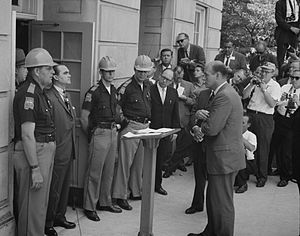
3) University of Alabama – George C. Wallace proclaimed that he would stand in the school house door to prevent any African American students from enrolling at the university—which he did, although he quickly stepped aside once his point had been made.
III) African American Action – the white reaction of massive resistance did not come mainly from government action, but from the pressure that African Americans, mainly young people (college and high school students), placed on the government to live up to the promise of equal opportunity. Martin Luther King became the focal point of the modern civil rights movement, but it was the actions of numerous African Americans--and some whites--the forced a change.
A) Montgomery bus boycott (1955)

1) Rosa Parks – Mrs. Parks was much more than the popularly portrayed old woman who was tired from a day at work; she was secretary of the local NAACP chapter, and had had regular run-ins with the Montgomery Bus Company over her treatment on the buses.
2) E.D. Nixon – Nixon was an official in the local chapter of the Brotherhood of Sleeping Car Porters, and the president of the NAACP chapter; at the beginning of the boycott, he sought out all the local black ministers to lead the boycott, feeling that this would make it seem less radical to other blacks; he first asked the new minister at the Third Baptist Church, Martin Luther King, who declined; after all other ministers also declined, Nixon was able to persuade King to assume the responsibility.
(a) Nixon and others coordinated the car pool service, which replaced the bus service in the black community; many of the drivers were college students who stayed home to provide the service

3) Martin Luther King, Jr. – feared about maintaining his new pastorate, with this high-profile task, and about the safety of his family (rightly, as it turned out, since shortly after his assuming leadership of the boycott his home was firebombed)
(a) After nearly a year, the Montgomery Bus Company capitulated, and agreed to remove the boards that segregated the riders.
B) Result of the success of the boycott guided King into a new role

C) Lunch counter sit-ins
1) Greensboro, NC – Greensboro was a city that prided itself on its progressive race relations; when 4 North Carolina A & T freshmen—Ezell Blair, Jr., David Richmond, Joseph McNeil, and Franklin McCain—decided to sit at the Woolworth’s lunch counter on February 1, 1960. The next day, these four were joined by twenty more; and eventually hundreds more (including a contingent of white female students from the nearby North Carolina Women’s College)
(a) Inspired black students throughout the south to similar actions.
2) Nashville, TN – led by students from the American Baptist Theological Seminary and Fisk University like John Lewis, Marion Berry, and Diane Nash, who were in turn led by a northern born black minister named James Lawson, who was committed to using Gahndian non-violent methods to foster social change.
3) Atlanta University – the “Black Ivy League;” led by Lonnie King and Julian Bond, who attempted to integrate public facilities in Atlanta; group was quickly arrested and they spent most of the day in jail—but this action turned middle-class blacks into freedom fighters.

D) Student Nonviolent Coordinating Committee (SNCC) – at a meeting on April 16, 1960 in Raleigh, NC SNCC was formed; decided to remain independent from other civil rights organizations like NAACP, CORE, and SCLC.

E) Freedom Rides (1961)
1) Nonviolent confrontations – attempt to integrate interstate bus transportation
(a) Birmingham, AL –1st bus was allowed to leave but the KKK firebombed the bus on the highway, and the passengers were beaten as they tried to escape the inferno, until the US Marshall accompanying them drew his pistol and fired it into the air; 2nd bus of riders was set upon the group of whites at the bus station in Birmingham, and were allowed to beat passengers for five minutes before police showed up (by pre-arrangement).
(b) Mississippi – less violence then in Alabama, but the passengers were arrested and charged with “inflammatory riding,” saddled with high bails and eventually with unreasonably long jail terms (some even served time at Parchman Farm)

F) Albany (GA) Movement (1962) – an attempt by local African Americans to integrate public facilities, and to open bi-racial talks; the movement was led by SNCC until a local group called in King, which led to a sometimes bitter internal struggle. Albany police chief Laurie Pritchett restrained his officers from publicly abusing the protesters; the lack of conflict led to an overwhelming defeat.

G) Birmingham – after the lesson of Albany, King realized that he for nonviolent tactics to be successful, he needed a foil that would be more physically active than Pritchett.
1) Television – the violence of the Birmingham police, and their attack dogs and high-pressure hoses, repulsed much of the nation—and won a great deal of sympathy for the civil rights movement
2) Youth join the Movement – as more adults were arrested in Birmingham during the protests, King okayed the use of teenagers (and younger children) who faced Bull Connors’ police and dogs and fire hoses, which increased the impact for viewers on television.
3) “Letter from Birmingham jail” – King’s most famous writing distilled the aims of civil rights movement.
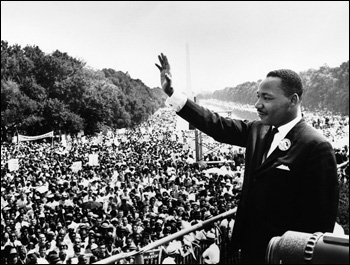
H) March on Washington – King’s “I have a Dream” speech, which was predated by a much angrier speech by SNCC leader John Lewis (which was less angry then it was originally intended, because the UAW’s Walter Reuther threatened to pull the union’s funding from the March).
I) Civil Rights Act (1964) – LBJ’s greatest moment, despite the rift it caused with former Senate colleagues.

J) Freedom Summer (1964) – the program created by SNCC to register black Mississippians to vote; recruited black and white college students, who were trained in nonviolent tactics at Miami University in Oxford in the spring of 1964.
1) White volunteers – SNCC first recruited a large number of white volunteers in 1963, in an early voter registration drive.
2) 1964 – more whites joined the effort; the hope of SNCC leaders was that by having prominent whites involved (including the son of California governor Pat Brown—Jerry Brown) there would be less danger for all involved
3) “Mississippi Burning” – three SNCC volunteers—one black and two whites—were kidnapped and murdered by the KKK
(a) Inordinate attention paid to the deaths of the white volunteers, which caused resentment among SNCC members; from this point white members are asked to leave the organization, and the black pride attitude becomes more prevalent.
K) Voting Rights Act (1965)
1) Selma – home to another reactionary racist, Sheriff Jim Clark; the police chief Wilson Baker maintained peace in the city early on—which hindered the voting rights campaign greatly.
(a) Decided to begin marching registrants to the Dallas County Courthouse, which Clark found provoking; Clark responded by ordering his deputies to beat protestors, despite the presence of television cameras
(b) “Bloody Sunday” – March 7, 1965; Hosea Williams and John Lewis led marchers, who were met at the Pettis bridge by the combined force of the Dallas County deputies an the Alabama State Troopers, who descended upon the marchers with a rebel yell and club all marchers they could reach senseless; ABC interrupted the movie “Judgment at Nuremberg” (the trial of another group of racists) to broadcast footage of the carnage.
(c) Presidential address – LBJ addressed a joint session of Congress calling for the passage of the Voting rights act, and quoted the famous song of the Movement “We Shall Overcome.”
(d) March 21—march to Montgomery resumes; Wallace was called to Washington and given the “Johnson treatment.”
(e) Bill signed into law August 6, 1965.

L) Poor People’s Campaign
1) Memphis Sanitation Workers’ Strike—1,300 municipal workers in Memphis walked off their jobs in protest of years of ill-treatment. Just a week before, 2 sanitation workers were crushed to death in a malfunctioning garbage truck. Many sanitation workers, in fact, still qualified for welfare after working a 40-hour week. African Americans were relegated to the dirtiest, lowest-paying jobs, with not chance for advancement. In addition, African American workers were regularly verbally abused by white supervisors, including grown men being referred to as "boy."
2) Assassination of MLK--King had earlier visited Memphis, at the beginning of the strike, and promised to return to assist the workers in their struggle. King returned to the city on April 3, and a huge rally was held that evening at a local African American church. The next evening, as King was waiting to go to dinner on the balcony of the Lorraine Motel, he was shot and killed by an assassin hidden in a building across the street. Mayor Henry Loeb still refused to negotiate with the sanitation workers, however, and President Lyndon B. Johnson sent his own negotiator to settle the dispute. An agreement was finally reached on April 18 that ended the strike; the union had to threaten another strike that summer, however, to get the city to live up to that agreement.
IV) Conclusion
Tuesday, April 3, 2012
Written Assignment 12

Tuesday, March 27, 2012
Written Assignment 11
The Cold War at Home


1. Little Steel--the steel companies besides US Steel were hoping to break the union (the companies of Little Steel had resisted unionization to the bitter end
B. Electrical Workers
C. Rubber Workers

1. "Open the books"--Reuther demanded at the bargaining table that General Motors present proof that it could not grant the demanded wage increase because of financial considerations--and that proof would be GM "opening the book," or financial ledgers, of the company.

1. Pittsburgh, Pennsylvania
2. Rochester, New York
3. Lancaster, Pennsylvania
4. Oakland, California

A. Office of Price Administration (OPA)--fearing that inflation would cause a recession that would stunt peacetime recovery, the wartime agency--now headed up by former Toledo mayor Michael DiSalle--was kept in the hope that it could control inflation; the agency was unsuccessful in this attempt, however.
B. Post-war recession--with wartime contracts ended, industry cut back production in the anticipation that there would be a recession--despite the fact that these contracts guaranteed these companies a profit for the next year.

1. "Coziness" with labor--labor was already seen as exceedingly close with the Democratic Party, and therefore the party was blamed in the mainstream press and by the business class for not "controlling" labor in 1946.
2. 1946 Election--Republicans win majorities in both houses of Congress for the first time since 1930. It is generally argued by political scientists and historians that general weariness with "change" as well a desire to "give the other guys a chance," along with Truman's unpopularity, also contributed. These factors did effect turnout of Democratic voters, and allowed Republicans to gain control of the Senate (they increased their control in the House of Representatives, which they had won in the 1944 election--despite FDR prevailing in the presidential election).
D. 1947 Legislation
1. Taft-Hartley Act--amended the National Labor Relations Act to disallow sympathy strikes and boycotts. Gave states the right to outlaw the union shop, the so-called "right to work" (without belonging to a union).

1. Democratic Party Split
a. Progressive Party
b. State Rights ("Dixiecrat") Party
2. Civil Rights plank
a. Desegregating the Armed Forces
3. Lackluster Republican campaign--combination of what Truman labeled the "do-nothing" Congress, and a lackluster campaign by Thomas Dewey, who was running not to lose rather than to win.
A. Communist spies
1. Rosenberg trial--the conviction of Julius and Ethel Rosenberg
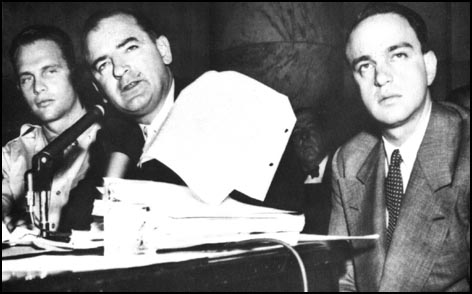
B. Rise of Joe McCarthy
1. Early political career
2. Wheeling (WV) speech
3. Army-McCarthy hearings
Sunday, March 25, 2012
The Global Cold War
I. Hiroshima and Nagasaki
 A. Hiroshima--both Hiroshima and Nagasaki had been left relatively undamaged by the firebombing raids undertaken by the Army Air Corps, so the damage of a nuclear attack could be accurately assessed. The first raid, the attack on Hiroshima, took place on August 6, 1945, when the Enola Gay dropped one of the three atomic bombs that the United States had manufactured to this point, nicknamed "Little Boy." The effects were devastating. Although the bomb only carried about 100 pounds of Uranium-235, it had the blast effect of 13 kilotons of TNT. The resultant blast destroyed everything within a mile of ground zero, and the resultant fires burned everything within a 4.5 mile radius. This raid (a convoy of three B-52 bombers, which the Japanese didn't even attempt to intercept) probably killed between 70,000-80,00 people immediately, with the casualty numbers rising to about 160,000 people by the end of 1945 and perhaps as many as 200,000 by the end of 1950, as people died of injuries or the effects of radiation.
B. Nagasaki--Three days after the attack on Hiroshima, a second bomb, "Fat Boy," was dropped on Nagasaki. Because Nagasaki was a smaller city, the number of people killed was less, but the devastation overwhelming anyway.
C. Surrender of Japan--Justification for the raids on both Hiroshima and Nagasaki for the American government lay in the idea that the raids ended the war early, compelling the Japanese government to surrender. Yet the surrender did not come until August 14, over the continued protests from the military--and recent evidence suggests that it was the fear that the Soviet Union would be able to grab a larger portion of the Japanese northern islands that compelled surrender, rather than a fear of nuclear attack, that persuaded the Japanese government.

I) The Cold War in Europe
A) Truman and Communism
1) Distrust of Stalin – although FDR had developed a relationship of statecraft with Stalin, Truman did not develop the same level of trust as his predecessor; in fact, Truman believed that Stalin was one of the most dishonest, evil men that he had ever known (a fact that is hard to argue with, certainly).
(a) Cancellation of Soviet Lend-Lease Aid – at war’s end, Soviets denied any further access to lend-lease aid, which shut off their access to US military hardware.
 2) Influence of Winston Churchill – Churchill had never put the level of trust in Stalin that FDR did, so when Truman became distrustful of Stalin, Churchill was there to feed those fears, which he shared with Truman.
(a) “Iron Curtain” speech – in a speech at a tiny college near St. Louis, Churchill delivered his famous Iron Curtain speech, where he encouraged isolating Western European countries from those under the domination of the Soviet Union.
3) Nuclear terror – the US insisted, since it was the lone country that could possibly hold the interests of the whole world ahead of its own self-interests (or that its self-interests alone were of concern to the rest of the world), insisted that this country, alone, should control these new weapons of mass destruction.
 (a) Soviets successfully test Atomic bomb in 1949 – the acquisition of nuclear technology by the Soviet Union fed fears of the red menace at home. Part of this hysteria led to the construction of backyard bomb shelters, and the identification of public buildings that could also serve as temporary bomb shelters.
(b) Escalation by the US – after the Soviet Union acquired nuclear capability, the US went ahead with the development of the more powerful Hydrogen bomb, which had ten times the killing power of the atomic bomb.
4) Policy of containment – an increased confidence on the part of the military and diplomatic elite after the US successes in the second World War led to a belief that the military might, or the threat of the use of military might, of the US could “contain” the influence of the Soviet Union as it was constituted in 1946.
 (a) George F. Kennan – was the diplomat stationed in Moscow who came up with many of the theories, and the term, which we now refer to as constituting the policy of containment
(b) Truman Doctrine – the Truman doctrine went hand-in-glove with the policy of containment. The Truman doctrine pledged to aid countries in their fight against “communist aggression.”
(i) Plan was formulated in response to an ongoing civil war in Greece, which pitted forces that had fought against fascists in the world war (led by a number of communists) against those forces that had collaborated with the fascists forces (which of course was anti-communist, and therefore backed by the US government). The aid the anti-communist forces received helped them to prevail in the struggle.
(c) Marshall Plan – named after Truman’s secretary of state, Gen. George C. Marshall; was a $16 billion dollar plan (that’s $140 billion in today’s dollars) plan for the reconstruction of Europe. Money was even offered to countries in the so-called Soviet bloc, if they would agree to strengthen economic ties with the West. This plan worked great for countries with strong social democratic traditions (like Great Britain, France), but it mainly strengthened the grip of right-wing dictators around the world.
II) Cold War in Asia – The Cold War was by definition a global conflict, and the United States took a much more active role in Asia after the World War than it ever had before—perhaps because the Soviet Union, like the United States, also was a Pacific Ocean power.
 A) Fall of China – the Red Army of Mao tse-Chung prevailed over the forces of Chang Kai-shek in 1949, and Chang and his followers were forced to withdraw to the island of Formosa, just off the Chinese coast. Chang was a venal, corrupt leader, who lost this war despite the aid that he was provided by the United States; however, in domestic politics, Truman was blamed for the “loss” of China, and these domestic pressures in turn prompted and reinforced Truman’s commitment to militarily aid anti-communist governments in Asia
1) NSC-68 – a proposal by the National Security Council to triple the amount of money that the United States spent on defense. This increased defense spending in fact acts as a sort of welfare program for selected parts of the US industrial complex (mainly aeronautics, but also some other manufacturing concerns).
B) The “Domino Theory” – the need to oppose communism anywhere and everywhere it arose was fed by the fear that if communism were tolerated in one country, it would spread country by country, like dominoes toppling one after another, until the threat undermined the freedoms of the people of the United States.
 C) Korea – Kim IL Sung attempted to reunite his country, which had been portioned at the insistence of the United States along the 38th parallel. The US suspects that the Soviet Union is responsible for this intrigue, and immediately begins aiding anti-communist forces in the South, both with material and men. After some initial difficulties, the US military operation after a brilliantly executed flanking maneuver utilizing a large scale amphibious assault was quite successful, and the combined forces are able to push the so-called North Koreans back well above the 38th parallel—in fact, in direct contradiction of the orders of his commander in chief, Douglas McArthur pushed the North Korean forces above the area claimed by China as its border with China—at which time the Chinese Red Army joined the fight against the Allied forces. The US was initially overwhelmed, but eventually recovered, and the fighting bogged down at the end of the year about where it had started, at the 38th parallel.
D) Wars to end colonial domination – Because of the focus upon the battle against communism, the US government tended to support the re-establishment of colonial rule around the globe, rather than the indigenous populations which looked to the Declaration of Independence and the US Constitution for inspiration.
1) The French in Indochina
 (a) Opposed by the Vietminh – the Vietminh, led by Ho Chi Minh, had been supported by the US during the war against Japan, even though the OSS was aware that Ho was a communist. This attitude quickly changed after the conclusion of the war, however, and the United States supported France’s efforts to re-establish control over the Indochina peninsula. Because of the strong resistance of the Vietminh, the US had to increase the support it furnished the French throughout the early 1950s, even going so far as providing advisors. In 1954, however, a large French force was surrounded near a little hamlet called Dien Bien Phu, and forced to surrender. The US quickly stepped in here, and declared that the country of Vietnam should be divided along the 49th Parallel, into North and South Vietnam, until a plebiscite could be held to choose a popularly elected government. Former collaborators ran the south with the French, some of who had even converted to Catholicism. The promised election never happened.

B. Nagasaki--Three days after the attack on Hiroshima, a second bomb, "Fat Boy," was dropped on Nagasaki. Because Nagasaki was a smaller city, the number of people killed was less, but the devastation overwhelming anyway.
C. Surrender of Japan--Justification for the raids on both Hiroshima and Nagasaki for the American government lay in the idea that the raids ended the war early, compelling the Japanese government to surrender. Yet the surrender did not come until August 14, over the continued protests from the military--and recent evidence suggests that it was the fear that the Soviet Union would be able to grab a larger portion of the Japanese northern islands that compelled surrender, rather than a fear of nuclear attack, that persuaded the Japanese government.

I) The Cold War in Europe
A) Truman and Communism
1) Distrust of Stalin – although FDR had developed a relationship of statecraft with Stalin, Truman did not develop the same level of trust as his predecessor; in fact, Truman believed that Stalin was one of the most dishonest, evil men that he had ever known (a fact that is hard to argue with, certainly).
(a) Cancellation of Soviet Lend-Lease Aid – at war’s end, Soviets denied any further access to lend-lease aid, which shut off their access to US military hardware.

(a) “Iron Curtain” speech – in a speech at a tiny college near St. Louis, Churchill delivered his famous Iron Curtain speech, where he encouraged isolating Western European countries from those under the domination of the Soviet Union.
3) Nuclear terror – the US insisted, since it was the lone country that could possibly hold the interests of the whole world ahead of its own self-interests (or that its self-interests alone were of concern to the rest of the world), insisted that this country, alone, should control these new weapons of mass destruction.

(b) Escalation by the US – after the Soviet Union acquired nuclear capability, the US went ahead with the development of the more powerful Hydrogen bomb, which had ten times the killing power of the atomic bomb.
4) Policy of containment – an increased confidence on the part of the military and diplomatic elite after the US successes in the second World War led to a belief that the military might, or the threat of the use of military might, of the US could “contain” the influence of the Soviet Union as it was constituted in 1946.

(b) Truman Doctrine – the Truman doctrine went hand-in-glove with the policy of containment. The Truman doctrine pledged to aid countries in their fight against “communist aggression.”
(i) Plan was formulated in response to an ongoing civil war in Greece, which pitted forces that had fought against fascists in the world war (led by a number of communists) against those forces that had collaborated with the fascists forces (which of course was anti-communist, and therefore backed by the US government). The aid the anti-communist forces received helped them to prevail in the struggle.
(c) Marshall Plan – named after Truman’s secretary of state, Gen. George C. Marshall; was a $16 billion dollar plan (that’s $140 billion in today’s dollars) plan for the reconstruction of Europe. Money was even offered to countries in the so-called Soviet bloc, if they would agree to strengthen economic ties with the West. This plan worked great for countries with strong social democratic traditions (like Great Britain, France), but it mainly strengthened the grip of right-wing dictators around the world.
II) Cold War in Asia – The Cold War was by definition a global conflict, and the United States took a much more active role in Asia after the World War than it ever had before—perhaps because the Soviet Union, like the United States, also was a Pacific Ocean power.

1) NSC-68 – a proposal by the National Security Council to triple the amount of money that the United States spent on defense. This increased defense spending in fact acts as a sort of welfare program for selected parts of the US industrial complex (mainly aeronautics, but also some other manufacturing concerns).
B) The “Domino Theory” – the need to oppose communism anywhere and everywhere it arose was fed by the fear that if communism were tolerated in one country, it would spread country by country, like dominoes toppling one after another, until the threat undermined the freedoms of the people of the United States.

D) Wars to end colonial domination – Because of the focus upon the battle against communism, the US government tended to support the re-establishment of colonial rule around the globe, rather than the indigenous populations which looked to the Declaration of Independence and the US Constitution for inspiration.
1) The French in Indochina

Subscribe to:
Posts (Atom)