Tuesday, March 15, 2011

The Second New Deal

I) Three Strikes


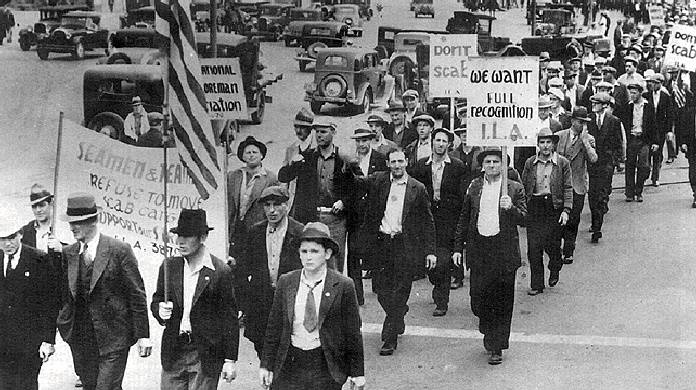
A) San Francisco Longshoremen’s Strike

1) Grievances


(a) The shape-up – longshoremen at this time were hired like day-laborers; they showed up at dock gates in a port, and the hiring boss chose those he was disposed to choose. If workers provided him with a reason to choose them (connections, bribes, kickbacks on the wages they were to receive that day), they were, of course, more likely to be chosen. The most important battle as far as the workers were concerned was to gain control of hiring practices (known as the hiring hall) so that they could control who would be sent to what job.


(b) Master agreement – workers demanded that all shipping firms agree to the same terms of contract, so that all workers on the west coast would be treated the same, and so that workers in other ports could not be used to whittle away the gains others might make.


2) International Longshoremen’s Association (ILA) – the ILA was the nominal union on the west coast, although its influence was flagging during this time; its real source of power was its control of the ports on the east coast, and on the Gulf coast. The ILA was led by a man named Joe Ryan, one of the most spectacularly corrupt union officials in history; as the strike on the West Coast dragged on, he flew in and attempted to make a separate peace in each port, rather than the master agreement that was one of the demands of the workers; only the longshoremen of Seattle gave in to this ploy, however.

(a) Harry Bridges – the leader of the San Francisco local was named Harry Bridges. Originally from Australia, Bridges was a brilliant organizer. Although he was probably a member of the Communist Party, he unfailingly put the interests of his members first (although this did not stop efforts by the US government to try and deport Bridges for much of the next forty years as an undesirable alien).


3) Battle of Rincon Hill – on July 5, San Francisco police attempted to put an end to the city’s portion of the longshoremen’s strike by attacking pickets at Rincon Hill, killing two and injuring 109 others. This blatant favoritism by the police led to workers in the city to call for a general strike, which took place for the following two days. Workers took over many city functions during that time period—directing traffic, etc. The international office of the AFL, however, demanded that the San Francisco CLU end its support for the general strike, which they almost immediately did and the strike quickly ended.


4) Settlement –the longshoremen’s strike went on for another three weeks after this, however, ending on July 31, after 11 weeks, with an agreement to arbitration on the outstanding issues. Through vigorous job actions over the next year or so, however, longshore workers were able to gain most of their demands.


B) Minneapolis Teamster’s strike


1) Citizen’s Alliance – an alliance of business citizens, that is. This group of business leaders was determined to keep Minneapolis a bastion of the open shop.


2) Teamster’s Local 574 – led by a group of militant truck drivers who had been expelled by the Communist Party in 1928—namely the three Dunne Brothers (Vincent, Grant, and Miles) and Karl Skoglund—who were determined to organize truck drivers in the city.


(a) February 1934 Coal Driver’s Strike – the first blow to the Citizen’s Alliance leadership in the city was this strike; obviously, a great number of Minneapolis residents needed coal in the middle of February. The quick success of this strike made the organization of other truck drivers and warehouse workers much easier; by the middle of May the local boasted of over 5,000 members.

(b) May 1934 strike – called after employers refused to bargain with the union; many members of the Citizen’s Alliance were deputized. The Teamster local’s Woman’s Auxiliary was also involved in the strike; when this group was attacked by the police and five members were sent to the hospital, 35,000 building trades members declared a sympathy strike, with the city’s CLU supporting the decision. After several bloody battles, the employer’s group agreed to bargain with union.


(c) July 1934 strike – the union distrusted the employer’s association, and began almost immediately to prepare the membership for another strike, which came July 16. The crux of disagreement was jurisdiction over so-called “inside” workers (inside the warehouse, that is). Teamster’s Local 574 wanted to transcend craft unionism and move toward industrial unionism, which the employer’s association opposed—as did the union own international president, Dan Tobin.


(i) “Bloody Friday” – small group of “flying pickets”  were ambushed by the Minneapolis police (as an investigation by Minnesota governor Floyd Olson proved), with the result that two of the pickets died. Some 40,000 workers marched in the funeral procession for their two stricken comrades.


(ii) Government arbitration – the arbitrators sent in by the government were distrusted by Local 574, and proved to be ineffective.


(d) Settlement – on August 22, the employers association agreed to union representation of inside workers, and all other union demands.

C) Toledo


1) February 1934 – strike effecting Spicer Manufacturing, Bingham Stamping, Logan Gear, and Electric Auto-Lite was called by Local 18384, a Federal Union, a sort of temporary union created by the Toledo Central Labor Union to begin organizing Toledo autoworkers.


(a) Little initial support at Auto-Lite – only 15 workers at the Auto-Lite plant joined the picket lines in February; only the solidarity of the workers at the other plants, and their refusal to go back to work without their fellow union members at the plant, got the Auto-Lite management to agree to take back the strikers and “bargain” with the union.


(b) Section 7a – (read the clause from page 15 of Korth book); “guaranteed” workers to choose a union, and to bargain collectively (the NIRA code gave manufacturers the right to set prices and production quotas amongst themselves, in return). Management attempted to meet this requirement by encouraging company unions; workers resisted this push, and attempted to establish unions under their control. In all three strikes, the main push for the workers was simply that management recognize the union as their bargaining agent.


2) Auto-Lite bargaining tactics – essentially, to stonewall the union in the hope that it would eventually fade away. Instead of bargaining in good faith, as the company had indicated that it would, they instead hired more workers, in order to expand the pool of trained strikebreakers, in the anticipation that another strike would follow in the immediate future.


(a) C.O. Miniger – owner and manager of the company since the company had moved to Toledo from Indiana to supply headlamps for Willys automobiles. Sat on the board of directors of the Commerce Guardian Bank; when this bank failed in 1933, he used an advanced warning to pull out the money of his company and his own personal accounts, while thousands of ordinary Toledoans lost their savings in the failure of the bank.
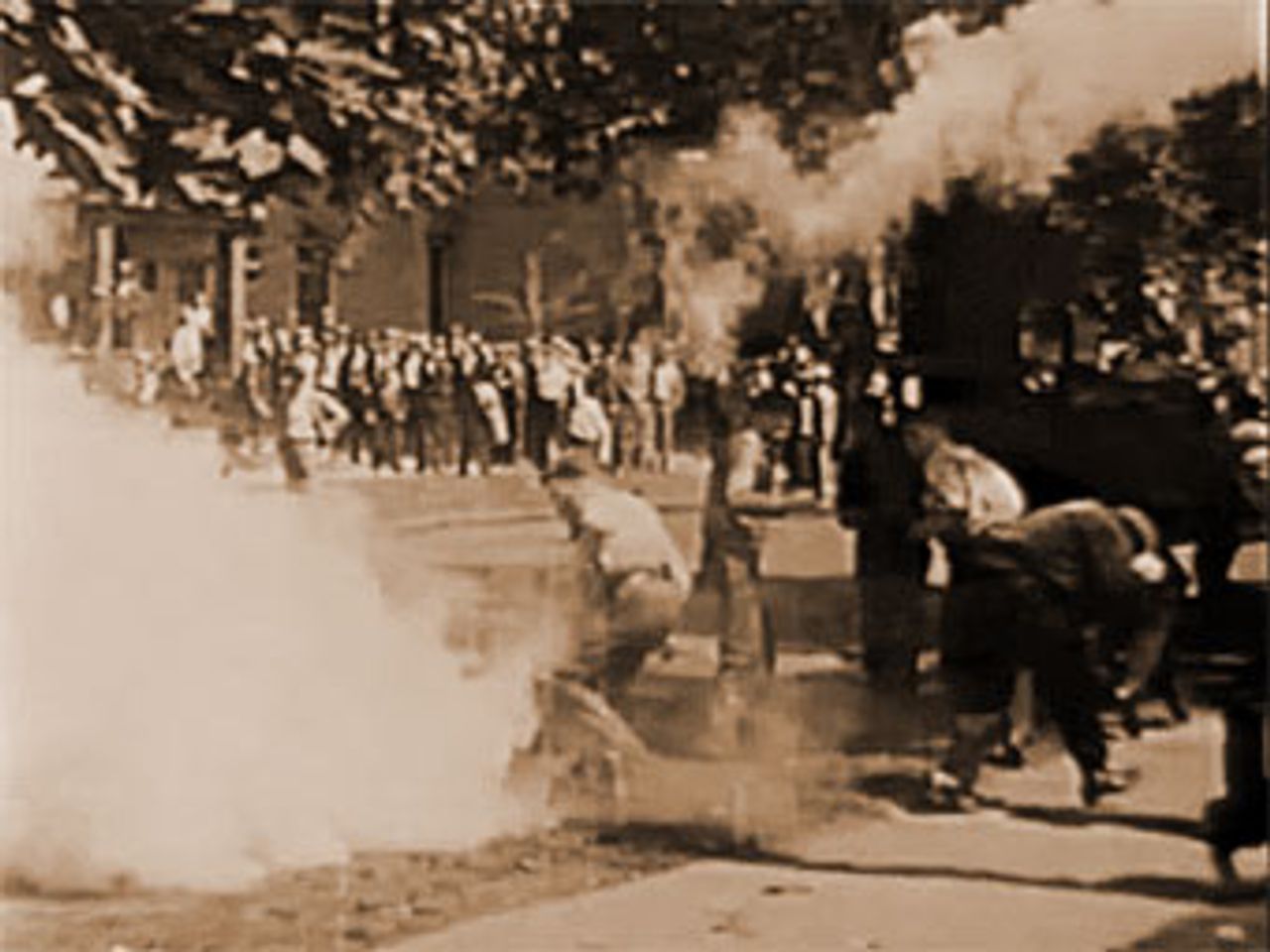

(b) Tear gas – the company also bought a large quantity of tear gas, in anticipation of trouble that would follow

3) Congress for Progressive Labor Action (CPLA) – later known as the American Workers Party (AWP), which still later became the Workers Party. This group was led at this time by A.J. Muste, a (then) former Dutch Reformed Church minister; this organization was peopled with believers in Leon Trotsky’s “permanent revolution” (as contrary to Josef Stalin’s “revolution in one country”), left-wing socialists who believed that the economic distress of the country gave them a ripe opportunity to overthrow the capitalist system of the country (a belief which many capitalists shared).


(a) Lucas County Unemployed League – formed in late 1933 to begin organizing the unemployed in the county (mainly in the city of Toledo). They accomplished this by using such tactics as a “death march,” where a group of unemployed marched slowly around the county courthouse, pulling a wagon with a bell sounding the death knell; and by taking groups of unemployed into restaurants and insisting the owner send the bill to the Lucas County commissioners.


4) Second Auto-Lite Strike – concentrated upon the Auto-Lite and two affiliated plants; Bingham Stamping, and Logan Gear, both of which were partially owned by Miniger as well.


(a) April 13 – pickets set up after the membership of the local voted to strike the night before; approximately 400 workers from the plant walked the picket line, while about the same number of workers crossed the picket line initially. Picket line numbers were increased by the participation of other union members, and by the participation by members of the LCUL.


(b) Injunction – strikebreakers were being roughed up, verbally abused, and intimidated (followed, sometimes up the steps of their homes). On May 3, company lawyers asked for, and received from Circuit Court judge Roy R. Stuart, a sweeping injunction, limiting the number of pickets to twenty-five, and preventing the participation by anyone who had not been an employee of the Auto-Lite. The immediate result of this was that the number of strikebreakers who reported for work greatly increased, allowing the company to run full production, and essentially defeating the strike.


(c) Violation of the injunction – at the suggestion of Louis Budenz (later a member of the Communist Party, and later still a born-again Catholic and FBI informer), the members of the LCUL announced, in an open letter sent May 5 to Judge Stuart, that they were going to violate the injunction—which they began the next day. The members (rather small at this early time) were promptly arrested, and brought before Judge Stuart, where they were admonished not do that anymore, and released—whereupon they promptly left the courtroom and marched back to the plant to begin picketing once again. This action encouraged other members of the LCUL to join in. They would get arrested, raise hell at the courthouse, and be released, only to head back to the picket line. This “street theater” began to attract large crowds in front of the factory—and more importantly, began to diminish the number of strikebreakers to cross the picket line.


(d) Community uprising – by May 23, more than 10,000 people, men and women, were on the picket line surrounding the factory. Deputized plant security was on the roof with tear gas. A female picket was struck on the head with an object thrown from the upper floors of the factory; workers responded with a barrage of bricks that continued through the night. At midnight, the Ohio National Guard was mobilized; by the end of the six-day disturbance, this would be the largest peacetime mobilization in Guard history. The disturbance only ends when Ohio governor White promises not to use the Guard to re-open the factory; with the factory finally closed, Auto-Lite management agreed to negotiate with the union.


D) Southern Textile Workers strike – although valiantly fought by southern workers, the dispersed nature of textile workers communities meant that they received little help in their strike, which led to its failure.


E) Labor successes – the three successful strikes of 1934 succeeded because the workers conducting the strike were able to rely upon other workers in the community—something the textile workers in the South, because of their isolation, were not able to do. Although workers were certainly inspired by section 7a, and by FDR’s apparent positive response to labor, they did not rely upon the government to help them win their battles against employers – a lesson that the CIO did not learn.

II) Works Projects (Progress) Administration (WPA) 1935-1942


A) Productive jobs – WPA employees saw themselves as workers and citizens, not welfare cases; workers received nearly double to rate of pay of workers on earlier programs (although, at FDR’s insistence, still below the rate of the private sector, so that no one would be tempted to live on government largess), and they were exchanging their labor for money, just as they had during their employment in the private sector


B) 8,000,000 people put to work during the life of the life of the program

1) Toledo – Anthony Wayne Trail, Toledo Zoo

2) Cleveland – numerous bridges, Memorial Stadium

3) The Ohio State guide series

C) Popular Culture and the New Deal
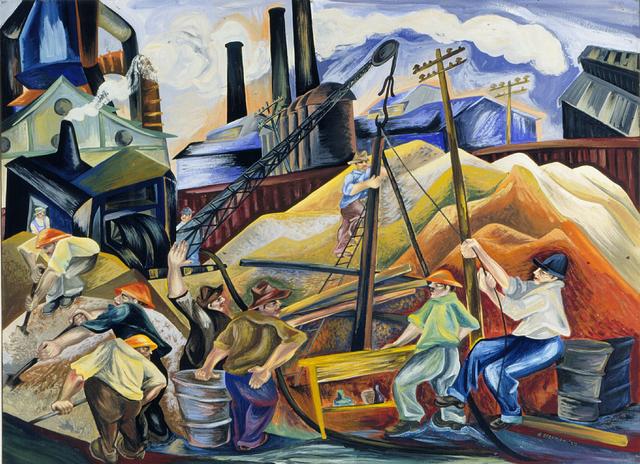
1) Art

(a) Murals – numerous murals were painted in public buildings, inspired by Mexican muralists like Diego Rivera and Jose Clemente Orozco (local examples include the Perrysburg Post Office and various buildings at the Toledo Zoo).

2) Federal Writers Project

(a) State guides – government funded “guides” were produced for each of the 48 states; larger cities also got their own guides.

(b) Slave narratives

(c) Narratives of immigrants and cowboys, as well

3) Federal Music Project

(a) Created 34 symphony orchestras

(b) Sponsored numerous dance band

(c) Collection of folk music (Alan Lomax)

4) Federal Theater Project – perhaps the most controversial of the federal projects

(a) Living newspaper – writers and actors collaborating to produce drama out of recent news, and dramatizing current events.

(b) Ethnic theater groups – Yiddish, Spanish language.

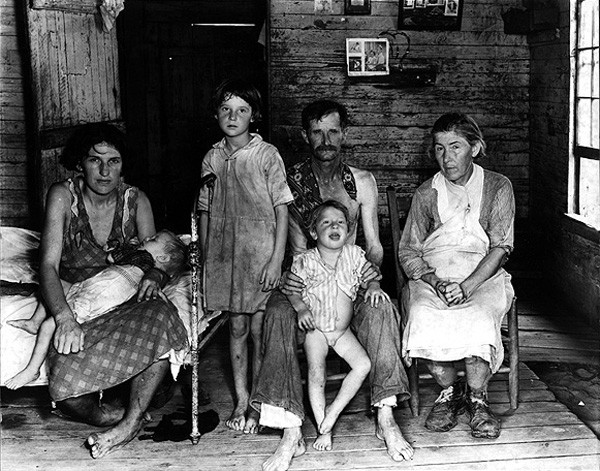
5) Photography – not strictly WPA; photographers were also hired by the Department of Agriculture, and particularly the Farm Security Administration. The photographers often were able to publish their photographs in popular magazines of the day. When viewing these photographs today, one should keep in mind that these photographers were hired to take photographs by government agencies, in the expectation that these materials would help the government build its case for specific government programs.

6) Cultural forces outside of government
(a) Woody Guthrie

(b) John Steinbeck – Grapes of Wrath and Of Mice and Men

(c) Warner Brothers Studio – the unofficial house studio of the New Deal; Jack Warner was FDR’s main supporter in Hollywood, outside of the acting and production talent.

7) Screen Actors Guild – although established earlier, the Screen Actors Guild becomes more of a force to be reckoned with during this time period (in fact, a second banana actor named Ronald Reagan begins a second career when he rises to the presidency of the organization in the 1950s).

III) Social Security Act (1935) – now synomomous with an old age pension, the program encompassed much more than this at its inception; it was an attempt to build a European-style welfare state, with cradle-to-grave coverage.

A) Help for the elderly

1) Immediate aid – a whopping $15 a month

2) Federal pension financed by payroll tax split evenly between workers and employers

B) Unemployment insurance – administered at the state level, which meant that compensation was higher in the north than in the south; the program was meant to counteract the insecurity caused working families caused by temporary layoffs.

C) Political, rather than fiscal, issue – because the program was supported by a tax paid by workers and employers (for whom the workers produced a profit), workers felt that they had “earned” benefits, which made it appear to them (and some of the more conservative elected officials who represented them).

D) Aid to Dependent Children – granted on a monthly basis, after a social worker visited the family to ascertain their needs.

E) Racial Inequalities – as the potential for more non-whites began to receive these benefits, the benefits became more controversial.

1) Racial code of the Social Security Act – the act excluded, at the insistence of Southern legislators, agricultural workers and domestic servants—or about 60% of the African American workforce.

2) Sharecroppers and farm laborers – excluded from benefiting from unemployment insurance, as well

3) Disparities in Aid to Dependent Children – families in Arkansas received approximately 1/8 of the total aid given to families in Massachusetts

F) Fair Labor Standards Act – ended ½ day on Saturdays as a usual workday, and made the 40-hour week standard nation wide; the FLSA also pegged the minimum wage to Southern wages of textile and lumber workers, in the hopes of eventually raising those rates.

G) Wagner Act – officially known as the National Labor Relations Act, but named for its Senate sponsor, Robert Wagner of New York.

1) Hoped to answer two problems

(a) Industrial unrest and social turmoil – as was seen in the labor actions in 1934

(b) Wage stagnation and under consumption – these two problems were seen by an increasing number of people in the New Deal as the reason for the Depressions grip on the economy of the country.
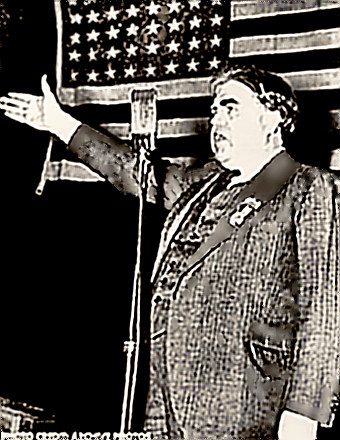

VI) Rise of the CIO – initially these letters stood for the Committee for Industrial Organization; after the break away from the AFL, the organization became known as the Congress of Industrial Organizations.

A) Formed in the fall of 1935 – by unionists inside the AFL who believed that unions had to begin organizing workers by industry to begin combating the economic clout of large corporations.

1) John L. Lewis – president of the UMW; to this point Lewis was an autocratic leader (and he remained that in the UMW). Lewis’ change of heart was probably dictated by his unions inability to organize “captive” mines—that is, the mines owned by the steel companies.

(a) Communist organizers – Lewis utilized numerous Communist and Socialist organizers in his drive, mainly because of their superior organizing results. When asked if he were concerned that these organizers might persuade workers to join these other organization, Lewis replied, “Who gets the pheasant, the dog or the hunter?”

B) Flint Sit-Down Strike (1936-1937) – in many ways, this strike was the defining moment for the early CIO, and certainly for the fledgling United Automobile Workers (UAW).

1) GM employed 80% of the Flint workforce at this time, either directly or indirectly, so the economic impact of the company on the community was huge, and the corporation could usually rely upon city government to be compliant with their wishes.


2) GM workers began strikes around the country in November and December of 1936.


(a) Toledo GM workers – had successfully struck the Chevrolet Transmission plant on Central Avenue in the spring of 1935, with hardly any violence; many Toledo union members had advocated asking other GM workers to go out on strike as well—in fact, a caravan drove to Flint. The AFL representative actively discouraged this action, however. The corporation responded by pulling out half the machinery in the plant over a Thanksgiving lay over, with a resultant loss in jobs.


(b) UAW plan – the leadership of the union planned to strike Fisher Body plants in Cleveland and Flint after the start of the year, when workers received a bonus from the corporation, and more labor-friendly administrations took office in Ohio and Michigan


3) The Sit-Down Strike – this tactic allowed a militant minority to shape events; by occupying the building, workers were able to ensure that their would be no scab replacements—and that the threat of attacks on the workers would be minimized because they were inside with all of the expensive machinery.

(a) First utilized in Akron – this tactic was first used by tire workers in Akron, even if Flint workers get most of the credit.

(b) Battle of Running Bulls (January 11, 1937)

(c) Workers seizure of Chevrolet Plant #2 forced GM to bargaining table.

IV) Presidential politics


A) 1936 Presidential election


1) Roosevelt Landslide – Roosevelt used a great deal of populist rhetoric in the election, calling the Republican Party “economic royalists” and “organized money.”


2) Roosevelt won 60% of the popular votes cast (greater than his victory over Hoover), and the electoral votes of every state except Maine and Vermont.


(a) African American vote – by 1936, African Americans voted overwhelmingly in favor of FDR over the Republican standard-bearer, in a reversal over long-standing tendencies to vote for the party of Lincoln. This occurs, despite some discriminatory practices in New Deal programs, for several reasons.


(i) “Black Cabinet” – second level bureaucrats and black leaders outside of the administration who provided advice to the administration; these African Americans were particularly influential upon Eleanor Roosevelt.


(ii) Eleanor Roosevelt – when African American singer Marion Anderson was refused the use of the DAR Hall in DC to hold a concert, Eleanor R. resigned her membership in the organization, and arranged for Ms. Anderson to give her concert on the Mall, on the steps of the Lincoln Memorial.


B) Roosevelt Recession – FDR’s lack of ideology comes back to haunt him; because he was not a true believer in Keynesian economics (explain Keynesian economics), Roosevelt was never comfortable with the sizable deficit that his government was running; with his sizable victory in 1936, he decided to greatly reduce spending in 1937, with disastrous results.


1) Economic recession – the Roosevelt Recession probably contributed most to the disenchantment towards Roosevelt, and the gains by conservatives in the elections in 1938.

2) Political backlash

(a) Reaction to “packing” the Supreme Court – a reactionary court had ruled against Roosevelt policies in numerous cases to this point; FDR advocated being enabled to nominate an additional justice for each one over the age of seventy-five (which would have added four additional justices to the bench); both Republican and many Democrats claimed Roosevelt was attempting to become dictator. The public fallout here was probably less severe than the bad press this generated for the President.

3) Backlash against labor

(a) Monroe MI – Republic Steel private police force gassed SWOC headquarters and set fire to it.

(b) Youngstown – Gov. Davey, who labor had supported in the 1936 election, read the handwriting on the wall, and used the National Guard to protect and escort strikebreakers to another Republic Steel plant on strike in this city. Phil Murray, whom Lewis had appointed to head up the SWOC Little Steel organizing drive, called for FDR to assist in this crisis, which he refused to do; this was the beginning of the rift between Lewis and FDR.

(c) Chicago Memorial Day Massacre – Republic Steel employees in Chicago on strike were rallying when Chicago police opened fire on the unarmed crowd, killing several; newsreel footage of this incident was withheld because officials feared it would be incendiary.

V) Conclusion

Sunday, March 13, 2011

The First New Deal


I)                   Poor People’s Campaigns

A)    Communist Party and Unemployed Council – led the agitation for rent relief and anti-eviction actions, as well as for direct relief, in many large cities.  The Communist Party was not the only left-wing political party active in this type of activity, however; the Socialist Party was active, as well as the American Workers’ Party, led by A.J. Muste (a former minister)

1)      Sharecroppers’ Union – active in Alabama, helping croppers fight for their rights; one such organizer, named Angelo Herndon, was charged and convicted of inciting insurrection in the States

2)      Scottsboro – role of Communist Party in publicizing this miscarriage of justice, as well as paying for the defense of the Scottsboro Seven (or the Scottsboro Boys, as they were popularly known at the time), increased the popularity of the party in the African American community.

3)      Ford Hunger March – from Detroit to River Rouge plant in Dearborn; Ford shutdown had forced more than 60,000 people onto relief rolls in Detroit.  A crowd of about 3,000 people marched, and were met with tear gas, fire hoses (in sub-zero weather), and bullets from the Dearborn police and the Ford Service Bureau thugs.  Four people were killed and more then 60 were injured; the funeral procession attracted 20,000 marchers while thousands more observed.

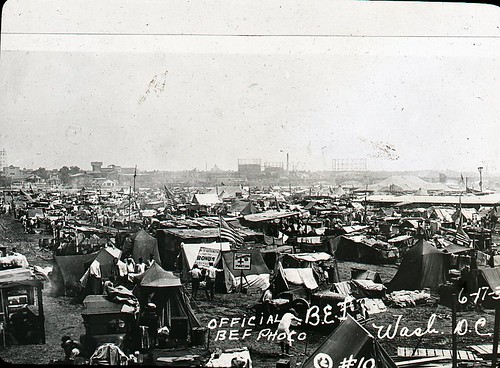
B)     Bonus Marchers – Congress had promised each veteran of WWI a bonus to be paid in 1945; 20,000 were soon camped out on the Mall to urge an immediate payment, which the House passed by the Senate did not.  In July, the Hoover administration decided to evict the protestors, which McArthur did with tanks, tear gas, and bullets.  Most American people were repelled by this action when they saw it on newsreels, and even more so when Hoover defended this action.

II)                 1932 Presidential Election

A)    Hoover’s popularity – Hoover, of course, was hugely unpopular; most of the blame and frustration with the economic woes most people were facing were placed upon him.

B)     Franklin Delano Roosevelt – promised to balance the federal budget (Hoover was running the largest peace-time budget deficit in the country’s history at this time) and trim the federal payroll; his stand on religion and drink were completely unexamined during the campaign (much to his benefit).  Roosevelt campaigned on the slogan “A New Deal for the American People.”

1)      Background – patrician (meaning he came from old money, as did his cousin TR).  In many ways, he tried to model his political career with that of his cousin’s—he served as New York assemblyman, secretary of the Navy, and he was the Democratic Party’s choice to run as Vice-President in 1920.  In 1921 he was stricken with polio, and was never able to walk without some kind of assistance after that.  That he was able to make a political comeback from this disease was due in large part to the assistance of his wife, his second cousin Eleanor.

2)      FDR won 57% of the popular vote (against an immensely unpopular Republican candidate); the only state that he lost outside of New England was Pennsylvania.

III)              First 100 Days – this has often been treated by historians as the implementation of the Roosevelt “plan;” however, Roosevelt operated during this time period without any plan, and often under conflicting advice from his advisors.  Most of the actions taken during these 100 days were forced upon the administration by events.

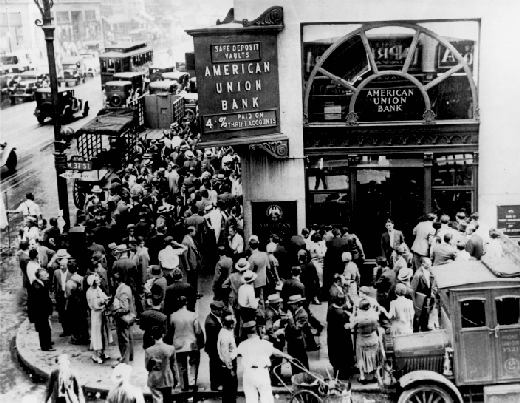
A)    March 1933 Bank Holiday – the first action that Roosevelt took during his administration was to order all banks closed to prevent a “run.”  Banks were allowed to reopen when they were able to prove that they were solvent.  While this sounds like a very drastic measure, it should be pointed out that 36 states had already closed the banks they chartered (and at this time there were only 48 states). This caused some temporary hardships, but as banks reopened they did so with the assurance that they were solvent—and thanks to the insistence of Michigan Republican Arthur H. Vandenberg, the federal government now protected bank deposits up to $2,500 through the predecessor of the Federal Deposit Insurance Corporation (FDIC).

B)     Fireside Chats – FDR became the first president to regularly use the radio to communicate with the American people.  FDR used a friendly, conversational tone on the radio, and many people came to look upon the president as a personal friend, someone who was interested in their welfare.  Because he also came to embody the government, many people came to see the government as directly interested in their welfare, as well.

C)     “Alphabet Agencies” – these agencies were populated with young Jewish and Catholic intellectuals, who were largely unwelcome in the Protestant-dominated business world.

1)      Federal Emergency Relief Administration (FERA) – the agency charged with providing funds for the unemployed.  Although the agency did hand out direct relief, much of the relief that people received they had to work for.

2)      Civilian Conservation Corps (CCC) – largely served young adult males; moved city boys into the country (away from those corrupting influences) to work on conservation projects.

3)      Civil Works Administration (CWA) – small scale public works projects, mainly road-building.

4)      Agricultural Adjustment Administration (AAA) – implemented a whole series of laws and policies to assist farmers; restored “parity”; government made payments to farmers for NOT planting crops, which acted to decrease the supply and force prices upward.  The timing of the implementation of this piece of legislation meant that many farmers had to destroy crops that were already planted as well as livestock.

(a)    Who benefited? – most of the benefit of these policies went to larger and corporate farmers, who could take more land out of cultivation

(i)      Southern Tenant Farmer’s Union – formed to protest this development; it was a bi-racial group, which of course was threatening to those in power in the South, and therefore was swiftly and violently put down (evictions, and attacks on road side camps)

5)      Public Works Administration (PWA) – funded larger building projects, like University Hall and the Glass Bowl, as well as much of the expansion of the Toledo Zoo, and eventually a new public library.

6)      Tennessee Valley Authority (TVA) – provided flood control for the Tennessee Valley (the Tennessee River flows northward from Alabama, through Tennessee and Kentucky to the Ohio River); the dams for this flood control also brought cheap electricity, which attracted industrial development in the area as well.

7)      National Recovery Agency (NRA) – perhaps the most famous of the alphabet agencies was the NRA. What the NRA proposed to do was to foment the development of cartels in the US economy—that is, to encourage the formation of monopolies. It was thought at the time that this would help stifle cut-throat competition, because companies would be allowed to collude together to fix prices and divide the market between themselves.

(a)    Section 7a – in return for being allowed to form cartels, businesses were to allow employees to join unions “of their own choosing.” This section was ambiguous on the point of whether these had to be independent unions, or whether they could be company unions. United Mine Workers president, however, sent organizers into the field with the message that “The President wants you to join the union.”

(b)    The NRA was overturned by the Supreme Court, and was the impetus for Roosevelt’s attempt to “pack” the Supreme Court (which had to this point blocked much of the New Deal legislation).

(c)    The NRA, headed by the mercurial (and possibly unstable) Gen. Hugh Johnson, had largely failed before it was killed by the Supreme Court. Compliance to the NRA codes was largely voluntary, and therefore businesses often failed to comply. Additionally, the union provision proved unsatisfactory to both businesses (who were, for the most part, extremely reluctant to work with labor unions) and labor (who were disappointed that Section 7a allowed the creation of company unions to compete with them).

Sunday, February 27, 2011

The Crash and the Onset of the Great Depression


I)                   Economic problems of the 1920s

A)    Farm Crisis – farmers were plagued with overproduction, falling farm prices, and declining income throughout the 1920s.

1)      Over expansion and debt – high prices during the war had encouraged farmers to increase their level of debt; when prices fell in the recession of 1920-21, they had great difficulty in repaying this debt.  Because there were no government subsidies, most farmers in the decade of the 1920s continued in this condition (or worse) for the next ten years or so.

2)      Non-Partisan League – called for government intervention (the government ownership of the grain elevators and slaughterhouses, easier credit, and tax exemptions for farm improvements).  This group was strongest in the upper Midwest (the Dakotas and Minnesota); it remained a force into the 1940s, particularly in Minnesota where it was transformed into the Farm-Labor Party.

3)      McNary-Haugen Bill – passed twice by Congress (1926 and again in 1927), but was vetoed both times by Calvin Coolidge.  This bill introduced the concept of farm parity (which was a guarantee that farmers could sell their crop at a higher price than it cost them to produce it).  A similar law was not passed until the New Deal.

4)      Rationalization of the family farm – more and more families were in fat being pushed off the family farm by the worsening economic conditions; this farmland was then bought up by corporations, who in turn then hired labor (often, the family who had been forced to sell their farm) to work on these farms.

5)      Dustbowl – on the Great Plains, the economic hardships were worsened for farmers by the onset of drought; this area had never received a great deal of rain (settlement had only been made possible by the techniques of “dry farming”), and the extended drought coupled with poor soil conservation practices produced the most famous images of the Great Depression.

B)     Decline of Organized Labor – the reaction against radical politics in general had a definite negative effect on organized labor; with the decline of organized labor also came a decline in the share of profits that workers got from the workplace.

1)      “American Plan” (its evil opposite would, of course, be the “un-American Plan) – the description of the corporate drive for the open (anti-union) shop; the closed (or union) shop imposed upon the “individual liberties” of the American worker.

(a)    Employer Welfare Plans – insurance, company athletic teams, and other company sponsored cultural and social events were all intended to fight the impression that workers labored for a coldly impersonal corporation that would throw them out into the streets as soon as an economic downturn occurred (which, of course, was the reality of the situation).

(b)   Company unions – gave the appearance of employee representation; in reality, company unions were a way of sidetracking employee complaints about working conditions and wages.  Corporations were able to push out or eliminate unions that were affiliated with the AFL, and replace them with unions that the companies could control.

2)      Decline of mature industries – with the decline of mature industries, in particular the coal industry, labor lost many members in these industries which it had already organized, while more workers were finding employment in newer manufacturing industries (like automobiles), that the AFL had never been able to successfully organize in the first place.

3)      Death of Samuel Gompers – Gompers died in 1924, while in office.  William Green, who had formerly been an official with the United Mine Workers, replaced him.  Green was not a dynamic leader, which the labor movement probably needed at this point desperately to battle against the tide of events.

4)      Continuing labor racism

(a)    Brotherhood of Sleeping Car Porters – led by A. Philip Randolph, by 1926 this union had several thousand members; the AFL, however, refused to charter the union, mainly because it had a largely black membership, and was led by an African American.

C)    The Business Cycle – the so-called “boom and bust” cycle was an ongoing phenomenon for which we really have no good explanation. However, depression had happened in the past (1837-38, 1857-1861, 1873-1877, 1885-86, 1893-1897, 1907, 1920-1921), but had largely been self-adjusting (that is, they were waited out without government intervention).

1)      “New prosperity” – according to economist Thorstein Veblen in 1921, this so-called new prosperity was based upon an “inordinately productive form of mechanical activity.”  Machinery was able to produce more goods faster with fewer workers; but ultimately this also provided fewer customers to buy these goods.

2)      Wall Street speculation – buying stocks “on margin” (that is, with money that was borrowed, in the expectation that the market would continue its upward trend.  When the market crashed, these investors had to pay back these loans, which often wiped out most of the gains (and then some) that they had made previously.

3)      Unemployment – increased from fewer than 500,000 to more than 4,000,000 between October and December 1929.

4)      Federal Reserve Board – had fueled Wall Street speculation by keeping interest rates low through most of the 1920s; after the crash, the Fed reacted by raising interest rates at exactly the wrong time.

5)      Smoot-Hawley Tariff (1930) – raised import duties to the highest levels in US history; this helped increase the downward spiral of the economy, as other countries responded by raising their tariffs, as well.  Many European countries went off the gold standard; Germany ended paying reparations because it was not receiving promised loans from the US, and France and Great Britain also ended payments on wartime loans they had received from the US.

D)    International economic crisis – we tend to forget that this was a worldwide depression, not only localized in the US.  In fact, because other countries were less hesitant to intervene through political means in their own economies, the depression was less severe and lasted a shorter time period than in the US.
E)     Hard Times – bread lines and soup kitchens became common sites in major US cities, and are our most common images of the Great Depression.
1)      Joblessness – in many of the manufacturing cities in the Midwest and East, unemployment levels ranged between 25% to 50% of the workforce (Toledo was at the high end of those figures).  Women, particularly married women, were forced out of the workforce, since they were there to earn “pin” money anyway, and were taking money out of the pocket of a male breadwinner.
2)      “Sharing the misery” – even those workers still employed were working greatly reduced hours; sometimes only 1-3 days a week, and often for six hours or less a day.  This allowed many more workers to remain on the job than would otherwise be the case; however, this method could only be used in larger manufacturing concerns, smaller ones could not afford to do this.
3)      Return migration – many southern whites returned to the South during this time, since it would be easier to eke out an existence back on the family farm among relatives and friends.  Not all internal migrants, however, chose to return to their former homes, or returned voluntarily.
(a)    Mexican nationals – many Mexican nationals had moved north to manufacturing jobs; with the onset of hard times local government officials and other workers often used intimidation to force these people to vacate their northern homes.
(b)   African Americans – remained in the North, preferring life there, as hard as it was, to returning to the South.  In part, this was probably caused by the increase in physical violence against blacks in the South; lynchings increased in the 1930s for the first time in a decade.
(i)                  Scottsboro Boys – nine young black men were found sharing a boxcar with two white women early in the Depression, so naturally they were charged with rape, even though no evidence was ever presented verifying that any kind of sexual intercourse had been taken part of.  The Communist Party gained the trust of a large portion of the African American population during this trial and the endless rounds of appeals for their role in the trial.
F)     Government response
1)      Crisis in confidence – consumer and business confidence in the expansion of the economy had created the extended economic boom; as the depression worsened and lengthened, this confidence evaporated.
2)      Hoover’s response – Hoover was in many ways the personification of progressive politics; a technocrat, an able administrator, who believed that politics could be made apolitical, and that rational decisions could be made after one was able to gather sufficient information.
(a)    Reconstruction Finance Corporation – a plan which loaned $700 million to failing banks and businesses; but the government also raised taxes to pay for this, which largely undercut its economic effectiveness.
(b)   Bonus marchers – victims of an overzealous cavalry charge led by Gen. Douglas Macarthur, who ordered the shanties torched after removing the occupants at bayonet point.
(c)    “Hoovervilles” – shantytowns that were thrown up using discarded scrap were referred to as a “Hooverville,” in a black humor poke at the man most people blamed for their abject condition.
G)    Poor People’s Campaigns
1)      Communist Party and Unemployed Councils – local agitation for rent relief and other kinds of assistance were often led by members of the Communist Party, or by those sympathetic to the immediate aims of the party in the affiliated Unemployed Councils.
(a)    Sharecroppers’ Union – active among black sharecroppers in Alabama
(b)   Ford Hunger March – the march on the River Rouge plant in 1932, demanding work; 4 marchers were killed, and more than 60 others were injured by the Ford Service Department (led by Harry Bennett and peopled by thugs) and the Dearborn Police (kind of an extension of the Ford Service Department).  More than 20,000 people in Detroit marched in the funeral procession, while thousands more watched in respectful silence.

II) 1932 Presidential Election

A) Hoover’s popularity – Hoover, of course, was hugely unpopular; most of the blame and frustration with the economic woes most people were facing were placed upon him.

B) Franklin Delano Roosevelt – promised to balance the federal budget (Hoover was running the largest peace-time budget deficit in the country’s history at this time) and trim the federal payroll; his stand on religion and drink were completely unexamined during the campaign (much to his benefit). Roosevelt campaigned on the slogan “A New Deal for the American People.”

1) Background – patrician (meaning he came from old money, as did his cousin TR). In many ways, he tried to model his political career with that of his cousin’s—he served as New York assemblyman, secretary of the Navy, and he was the Democratic Party’s choice to run as Vice-President in 1920. In 1921 he was stricken with polio, and was never able to walk without some kind of assistance after that. That he was able to make a political comeback from this disease was due in large part to the assistance of his wife, his second cousin Eleanor.

2) The new deal--for Roosevelt, the "new deal" was simply a campaign slogan, rather than a well-thought out plan to implement socialism, or to provide a social "safety net" for some Americans. Roosevelt was willing to try just about any program, as long as he was convinced that it might work. As we will see, Roosevelt was very unwilling to overthrow the capitalist system; rather, he was convinced that the system had to be saved (although he did prove more willing to campaign against some groups of people). In 1932, the only thing Roosevelt really promised to do was to balance the federal budget.

3) FDR won 57% of the popular vote (against an immensely unpopular Republican candidate); the only state that he lost outside of New England was Pennsylvania.

a) The interim period--the interim months between Roosevelt's election in November 1932 and his inauguration in March 1933 saw conditions in the country worsen, as the country entered the depths of the Great Depression. Despite an offer from Hoover to collaborate on policies to stem the suffering, Roosevelt chose to remain at his home in New York, and let Hoover and the lame duck Congress deal with the consequences (and take the blame for what was happening.


Sunday, February 20, 2011

The Rise of Consumer Culture


I)                   Mass Culture

A)    Radio – for the first time, a mass audience could experience an event at the same time.  Although this was used as a technique to keep alive ethnic cultures (polka stations, foreign language programs, etc.), it also allowed others outside that culture to experience it; business side led to mass entertainment to sell products—which in turn contributed to the homogenization of culture

B)     Phonograph records – a way to maintain ethnic ties as well; but once a record was distributed, there was no way to limit who would consume it, which meant that there was a great deal of interaction between cultures, which in turn created a new culture (Caruso, Sophie Tucker “The Last of the Red Hot Mamas,” the Austin High Gang of ethnics who frequented the jazz clubs of Chicago’s South Side and helped to create the swing music of the 1930s, particularly one Benny Goodman)


C)    Movies – 1920s were a boom time of the downtown movie palaces, which were paeans to consumer culture; as the star system became more refined, these actors became more and more used to sell products (cigarettes, automobiles, etc.)

D)    Automobiles – by 1929, 50% of American families owned an automobile, and the industry directly employed 375,000 people—with millions more indirectly employed because of it.


1)      Fordism – Ford’s contribution to the automotive industry was his drive to reduce the cost of the automobile, so that it would become more widely accessible to the general public; Ford accomplished this by increasing the number of specialized machines used to create parts for the automobile.  This had two advantages: it decreased his reliance upon skilled workers, who could demand higher wages; and it allowed him to set a specific pace of manufacturing, rather than letting the workers set their own pace

(a)    Model T – extremely limited choice (it came with no options, and in one color—black), but this allowed Ford to perfect its manufacture—which in turn allowed Ford to drop the price of the automobile from $950 when it was introduced in 1909 to $290 at the height of its popularity in 1924

(b)   $5 a Day – the famous $5/day wage, instituted in 1914, was approached by few workers, but it helped limit the turnover of 300%; the higher overall wage also allowed workers to purchase the product that they were manufacturing (analogy to Bush directives for Americans to do their “patriotic duty” and purchase stuff in reaction to Sept. 11)

(c)    Increased mobility – ownership of an automobile allowed many more people to move to the suburbs (or “into the country’); also created a greater demand for recreation—along with more workers employed in routinized labor.


2)      Sloanism – named after the President of the General Motors Corporation, Alfred P. Sloan.  Sloanism is in many ways the perfection of Fordism; automobiles were provided in a variety of styles (kind of), and a variety of price ranges

(a)    Creation of the General Motors Acceptance Corporation – GMAC created in order to provide financing for potential automobile purchasers who could not pay cash for an automobile.

(b)   Triumph of Sloanism – by 1927, falling sales of the Model T forces Ford to shut down production, and re-tool for the production of the Model A.  In 1924, Ford had commanded 55% of the new car market.

(c)    Increased importance of advertising – used to help people differentiate between largely undifferentiated products; advertising allowed companies to manufacture desires in their customers.

E. Sports--the 1920s were the "golden age" of sports.

1. Baseball--Babe Ruth was traded from the Boston Red Sox to the New York Yankees after the 1919 season, and became an everyday player instead of one of the best left-handed pitchers in baseball. The manufacture of the baseball itself was refined and made easier to hit fan-pleasing home runs--deemed a necessity after the so-called Black Sox Scandal, where members of the Chicago White Sox team were accused of "throwing" the World Series to make money for gamblers--to make up for the shortfall many players felt because they felt the owner of their team was less than generous with them.

2. College football--dominate teams developed in the Midwest during the 1920s, with the play of Harold "Red" Grange at Illinois and Bronko Nagurski at Minnesota joining the still formidable teams at Michigan and the University of Chicago.


3. Boxing--the "Roaring 20s" got their start here in Toledo in 1919, with the Jess Willard/Jack Dempsey prize fight that took place in Bay View Park. Willard defeated the champion Jack Johnson--the first African American to hold the heavyweight title--

II)                 African American Culture and Political Development in the North – the vitality and creativeness of African American culture first gets widespread recognition as more African Americans move north, and more white northerners come into contact with it.

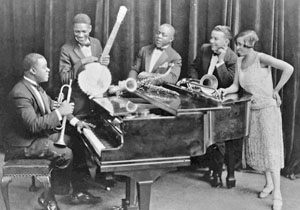
A)    Jazz – first comes north in the early 1920s—moved up the Mississippi from New Orleans to St. Louis, and then from St. Louis to Chicago; Louis Armstrong moved to Chicago from New Orleans, first with his Hot Five (which eventually grew into his Hot Seven).

1)      Southside Chicago – the area around 43rd and State was the heart of the African American community in Chicago, the so-called Black Metropolis.  It was here that a group of second generation ethnics from the west side Austin High School came to listen to the jazz bands that played the venues here, and by the late 1930s had transformed the sound into what we know as swing.

2)      New York – NYC quickly became a Mecca for African American jazz players, who found gigs in the burgeoning African American neighborhood in the city known as Harlem.

(a)    “Black and Tan Clubs” – clubs where “slumming” whites could come and listen to and dance to black combos, without having to be alarmed with having to mingle with too many African Americans, unless it was the wait staff or the musicians.  The Cotton Club became the most famous of the clubs.

3)      “Sweet” music and “hot” music – white dance bands toured the hinterlands playing “sweetened” versions of new “hot” jazz hits.  Bands like the Paul Whiteman Orchestra, who would hire a few “hot” players (most notably Bix Biederbecke), but played mainly toned down versions of jazz music.
III)              Reaction to Mass Culture

A)    Prohibition – outlawed the manufacture, and legal drinking; led to the flowering of organized crime.  By outlawing what had been acceptable, it grouped this behavior with other behavior that was looked down upon as well (secular music, dance, homosexuality) that then became tolerated in this developing underground society—and then more laws were passed to outlaw this behavior.

B)     Rise of Fundamentalist Religion – reaction to increased urbanization, increased social contact with Catholics and Jews in urban settings.  White southerners moving north also contributed to this.  Billy Sunday and Aimee Semple McPherson

C)    Rebirth of the KKK – became particularly active in northern cities (as well as much of the state government in Indiana); Catholics and Jews became as much a target of intimidation in the North as African Americans during this time.
D)    Scopes “Monkey Trial” – in Dayton, TN, ACLU convinced a teacher named John Scopes to violate recently passed creationist law; Clarence Darrow was the lawyer for the defense, and William Jennings Bryan was on prosecution team; Darrow called Bryan as an expert witness, and got him to admit to numerous embarrassing literal interpretations of the Bible—Bryan died soon afterward.